
You tell your backend expert: "We always use context.Context as the first parameter."
Two weeks later it writes a function with ctx buried in the middle.
That isn't always a model failure. Often the preference was never stored as a durable fact — it lived in chat, got summarized away, or drowned in tail history.
Neural Junkie already has conversation memory: retrieve relevant past messages when you ask a follow-up. Personal learning is the other half of the memory story: user-confirmed facts that shape how experts behave going forward.
Nothing is saved without your explicit approval.
Memory that recalls vs memory that teaches
| Conversation memory | Personal learning | |
|---|---|---|
| What it stores | Indexed chat + collab artifacts | Short user-confirmed notes |
| Default | On when embed model available | Off until you opt in |
| Who writes it | Hub indexes on message write | You approve every entry |
| Retrieval query | Your latest question | Your latest question |
| Typical use | "What did we decide about auth?" | "Always use pnpm, not npm" |
Both use local Ollama embeddings (nomic-embed-text) and stay on your machine. Neither sends your history to a cloud vector DB.
Conversation memory answers what happened. Personal learning encodes how you want work done.
Opt-in by design
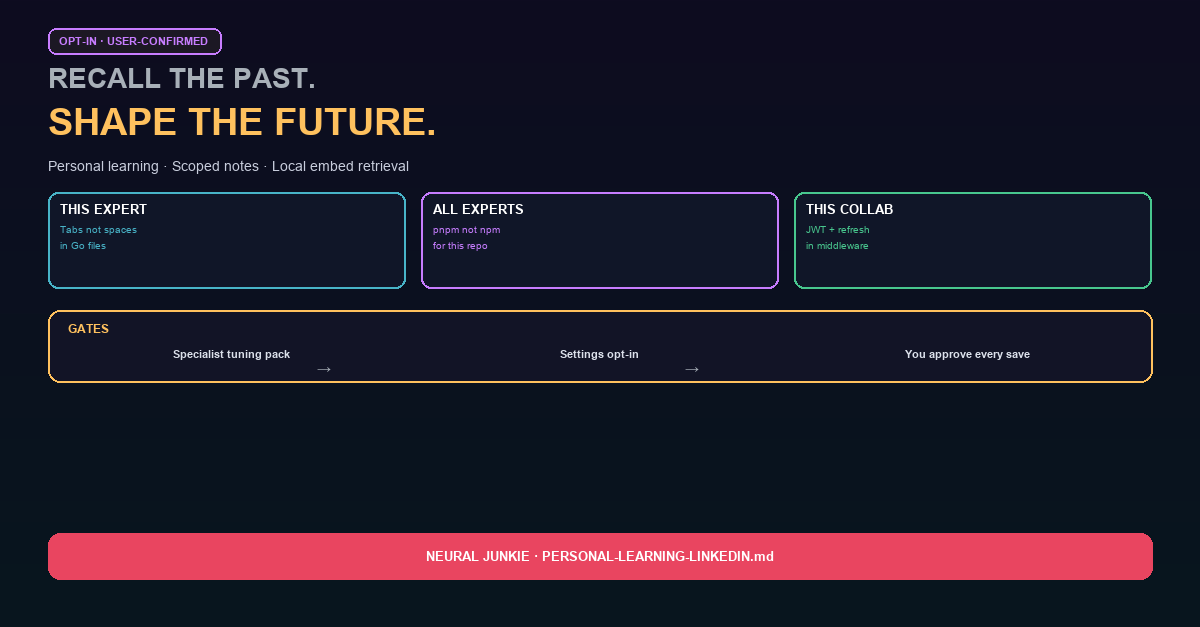
Personal learning has three gates:
- Specialist tuning pack installed (capability
personal-learning— no Python/CUDA required) - Settings → AI & providers → Enable personal learning for experts (default off)
- Your confirmation on every save — modal,
/learn, or Settings
Natural phrases like "remember that" or "I prefer" may open a proposal dialog. They do not auto-persist. Agent-suggested learnings are a separate toggle, rate-limited, and still need your click.
That is intentional. Silent training on chat is convenient until it memorizes a joke, a typo, or something you said once under deadline pressure.
Three scopes
When you save a learning, you choose where it applies:
This expert — injected only when that agent responds (e.g. SecurityReviewer always flags eval() in review comments).
All experts — global preferences every specialist sees (e.g. "Our API errors use {code, message} JSON").
This collaboration — scoped to an active /collaborate channel so a multi-agent session shares conventions without polluting unrelated DMs.
At prompt time the hub retrieves top matches per section and appends:
=== LEARNINGS FOR ALL EXPERTS (user-confirmed) ===
=== LEARNINGS FOR THIS EXPERT (user-confirmed) ===
=== LEARNINGS FOR THIS COLLABORATION (user-confirmed) ===
Budget caps keep injection small (~2 KB agent, smaller global/collab slices). If Ollama embed is unreachable, keyword overlap fallback kicks in within ~200ms.
Storage: ~/.neural-junkie/learnings.json plus a sidecar embedding index. Export/import bundles for portability. Edit or forget any entry in Settings.
How to use it
Quick capture: /learn we use conventional commits in a DM or channel — opens the approval dialog with a draft.
From agent info: Add learning on any expert's profile card.
Bulk management: Settings → Saved learnings — grouped by global, expert, and collaboration.
Categories: preference, fact, workflow, communication — for your own organization, not model routing.
Categories do not change which agent runs. Scopes do.
Bridge to LoRA
Prompt injection is fast and reversible. Sometimes you want the preference baked into weights.
Confirmed learnings can feed LoRA training:
- LoRA train panel → Include confirmed personal learnings
GET /api/lora/train/preview?include_learnings=1shows the row count- Training prepends Alpaca-format rows from approved notes (capped)
Same Specialist tuning pack, same local workflow as training from chat or collab history — but only rows you explicitly confirmed. See our LoRA article for compose and train details.
What we deliberately exclude
Personal learnings are not injected into CLI agents or the Moderator — those paths stay lightweight and policy-driven.
They complement conversation memory and session summaries; they do not replace repo indexes or MCP tool context.
If you disable the feature, existing entries remain on disk but stop injecting until you turn it back on.
Try it
make pull-models   # includes nomic-embed-text
make start-all
- Install Specialist tuning from Settings → Domain packs
- Enable personal learning under Settings → AI & providers
- DM BackendEngineer:
/learn prefer table-driven tests in internal/ - Approve in the modal → ask a new task → preference should surface in retrieved learnings
Debug: GET /api/learnings/query?q=... previews retrieval without sending a chat message.
Download: https://github.com/camronwood/neural-junkie/releases/latest
If a scope feels wrong (global note leaking into the wrong collab, embed fallback too noisy) — GitHub issues welcome.
Camron Wood — Neural Junkie (personal project)