
Neural Junkie is a desktop hub where you run multiple AI specialists — security reviewer, architect, biology expert, repo agent — on your hardware, under your control.
If every specialist needs its own full model, local multi-agent work gets expensive fast. A 14B coder here, an 8B biology model there, another 14B for security — disk, RAM, and pull time add up. Prompt personas help agents sound different, but they don’t change what the weights actually know.
LoRA (Low-Rank Adaptation) is what we added: small adapter files on a shared base model, composed into distinct Ollama tags at inference time. Same hub, same UI, same orchestration — different specialist behavior underneath, without five full model pulls.
Why LoRA, not just prompts
System prompts, lanes, and tooling are necessary — but not enough when you want domain-tuned behavior (security review that reads like security review), repo-specific fluency (patterns from your codebase, not only RAG snippets), and efficient local inference (LoRA adapters on Llama/Mistral bases while specialists default to Qwen for chat).
Adapters are typically tens of megabytes, not tens of gigabytes. Pull the base once, attach per specialist, and Ollama composes tags like nj-security:14b or nj-repo-myapp:14b. Prompt personas and the context stack stay unchanged; LoRA adjusts the model layer underneath. Routing, collaboration, MCP tools, and file approvals work the same.
Compose, don’t duplicate
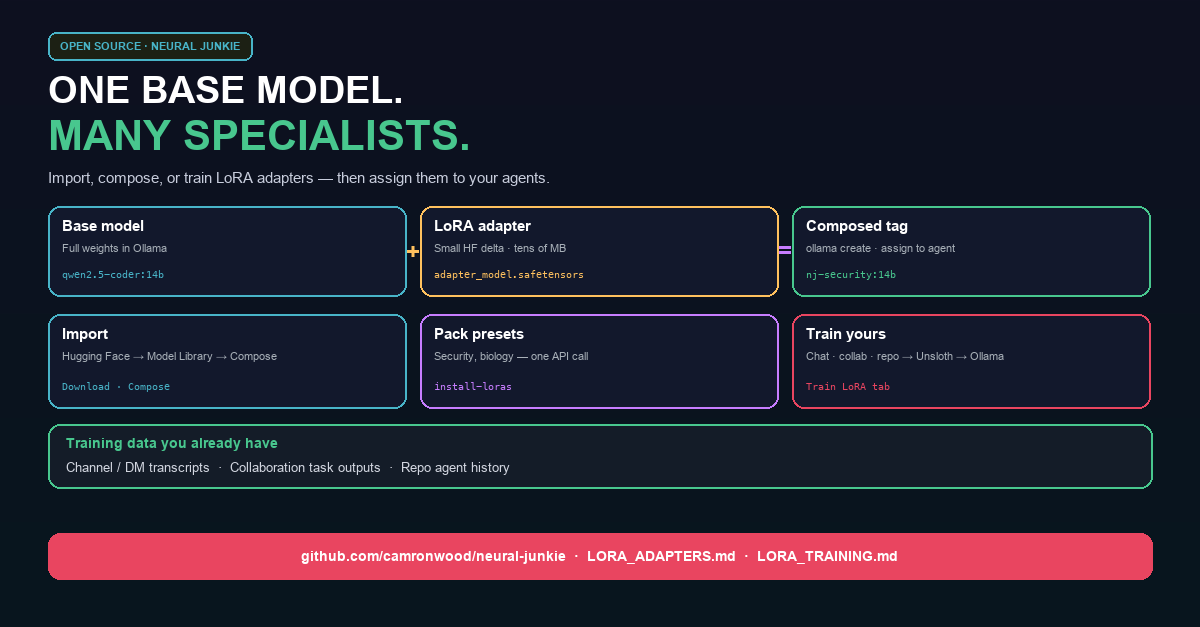
Three pieces: a base model (full weights in Ollama), an adapter (small Hugging Face LoRA delta), and a composed tag (what agents call at inference — e.g. nj-security:14b). Base + adapter → ollama create → assign to specialist. The hub handles download, compose, and assignment — no hand-edited Modelfiles per role.
Tag conventions: nj-{type}:14b for specialists, nj-repo-{slug}:14b for repo experts, nj-biology:8b on llama3:8b for the life-sciences pack.
Three ways to get a composed tag
Import from Hugging Face. Model library → Hugging Face → LoRA adapter → Download → Compose & import. Assign via agent info or /switch-provider (Settings → Advanced for bulk edits).
Domain pack presets (optional bootstrap). The Specialist tuning pack ships curated community adapters (security, code-review, backend, biology) — install via Pack store → Install LoRAs or POST /api/packs/specialist-tuning/install-loras. Assign tags manually in Settings; domain packs no longer auto-bind LoRAs.
Train from your history (hero path). Create a repo expert, accumulate Q&A, open agent info → Train LoRA (or Model library → Train LoRA). Sources: channel/DM transcripts, collaboration task outputs, or repo-agent history. Set base tag, output tag (e.g. nj-repo-myapp:14b), rank/epochs, Start. Hub exports JSONL, runs Unsloth (make deps-lora, optional CUDA), composes into Ollama on success. Minimum 10 rows; one job at a time.
What you can do with it
Security on a LoRA base. Install the Specialist tuning bootstrap LoRA — assign nj-security:14b to SecurityReviewer (composed on llama3.2:3b). See TWO-TIER-LORA-LINKEDIN.md for why inference and LoRA use different bases.
Biology without a second full 8B. nj-biology:8b from llama3:8b + MedMCQA adapter — from Specialist tuning pack, not life-sciences.
Repo expert from your sessions. /create-repo-agent on your repo, accumulate Q&A, Train LoRA from agent info → nj-repo-myapp:14b, assign back. Chat and collab become training signal.
Collab routing. With smart routing on, security tasks can prefer nj-security:14b locally when installed. Override per task with task_ollama_model when needed.
Train elsewhere, import here. Publish to Hugging Face, download in Model library, compose, assign — no lock-in to our trainer.
How it fits the product
LoRA is orthogonal to what you already use: context stack, collaboration phases, workspace gates, repo agents, and cloud BYOM providers. Fine-tuning is a model-layer concern; the hub still enforces gates and approvals regardless of tag.
Limitations worth knowing
Safetensors adapters only (not GGUF LoRA blobs). Each compose is a distinct Ollama tag — no hot-swap per request. Training is optional, separate, and not bundled with the hub. No auto-upload to Hugging Face. Tool calling follows the base model. Hosted HF inference stays full-model; PEFT compose is local Ollama. Quality still depends on training data and base choice.
Try it
Personal open-source project — macOS, Windows, Linux.
Download: https://github.com/camronwood/neural-junkie/releases/latest
ollama pull qwen2.5-coder:14b — then import from Model library, install pack LoRAs, or Train LoRA from channel / collab / repo.
Docs: https://github.com/camronwood/neural-junkie/blob/main/docs/LORA_ADAPTERS.md and https://github.com/camronwood/neural-junkie/blob/main/docs/LORA_TRAINING.md
Issues welcome if you train from collab output or hit compose edge cases — that feedback shapes the next pack preset.
Camron Wood — Neural Junkie (personal project)