
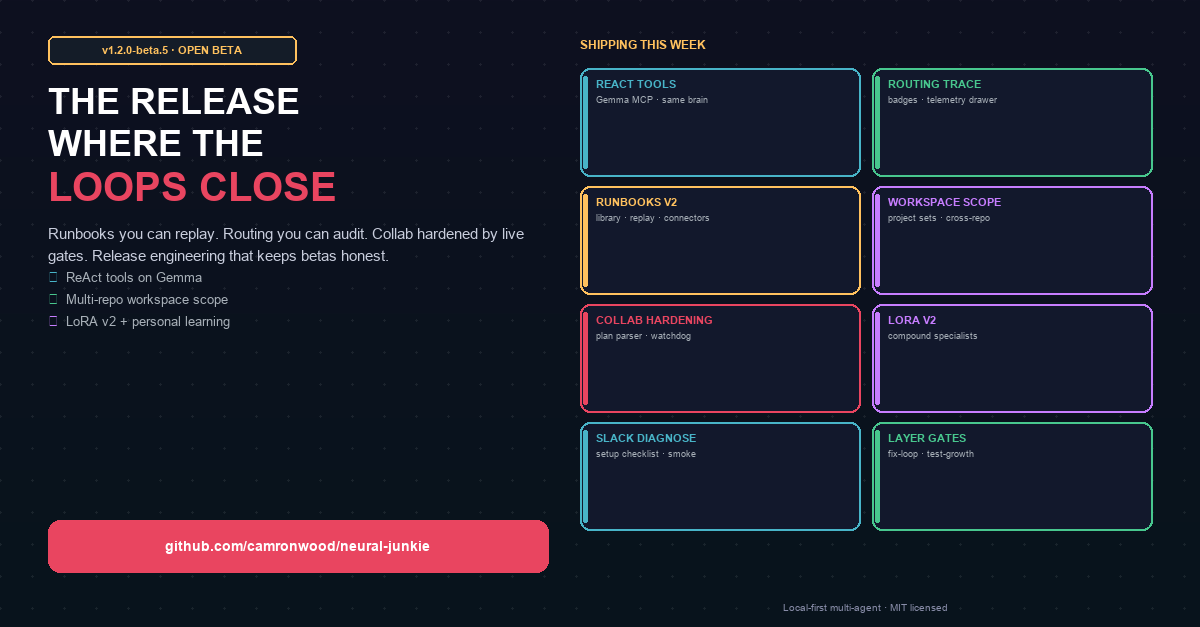
Neural Junkie v1.2.0-beta.5 is the open-beta release we have been building toward since beta.4: not one headline feature, but a stack of closed loops — repair, routing, collaboration, repeatable operations, and the test harness that proves they work on real local models.
If beta.4 was Agent Runtime reliability (fix loops, image gen, music pack, turn telemetry), beta.5 is what happens when those foundations meet operational maturity: runbooks you can replay, routing you can audit, collab you can regression-test, and specialists you can train without losing control.
Download: macOS, Windows, Linux — same local-first desktop app, same MIT-licensed hub.
The headline in one paragraph
You get ReAct MCP on models that lack native tool calling, per-turn routing trace on every chat and collab message, Runbooks v2 (persisted definitions + run history), multi-repo workspace scope via project sets, collaboration hardening from weeks of live scenario gates, LoRA v2 compound specialists, personal learning with explicit consent, Slack setup diagnostics, and layer-gate / fix-loop / test-growth automation so the next beta does not ship on vibes.
1. ReAct tools — one brain, not two models in RAM
Beta.4 gave you turn telemetry. Beta.5 completes a routing tier that beta users asked for loudly: run MCP tools on the chat model you picked, even when Ollama says that model has no native tools capability.
Gemma 3 12B is the first allowlisted tag. The hub wraps the provider in a ReAct loop with a strict contract:
<tool_call>{"name":"read_file","arguments":{"path":"src/App.tsx"}}</tool_call>
Native tool calling when available → ReAct on the same model → Qwen swap fallback when parsing fails or the iteration cap hits. The typing indicator tells you which path ran: (react_tools) or (react_fallback_swap).
That matters because "swap in Qwen for tools" worked — but it split persona, doubled RAM pressure, and hid the story in routing telemetry. Now you can keep one mid-tier model for chat and light MCP without pretending every Ollama tag is tool-native.
See the deep dive: Gemma Can't Call Tools. We Taught It Anyway.
2. Per-turn routing trace — stop guessing which model ran
Every substantive turn now carries routing metadata you can inspect without reading hub logs:
- Model tier and provider
- Retrieval mode (memory, codebase, none)
- Composer mode and context scope
- Implementation session state when relevant
In the desktop app: routing badges on messages, a live Turn telemetry drawer during generation, and a post-hoc Routing trace panel for debugging "why did that reply feel wrong?"
This is the user-facing half of the inference layer story — decide before you generate, then show the decision on the message.
3. Runbooks v2 — from one-off collabs to repeatable SOPs
Collaboration v1 was powerful and ephemeral: draw a DAG, approve, execute, done. Runbooks v2 adds ownership:
| Concept | What it means |
|---|---|
| RunbookDefinition | Named, versioned workflow with tasks, graph, policies, and inputs |
| RunExecution | One run — still a collaboration under the hood, with run metadata |
| Connector profile | Named Slack/webhook/HTTP credentials referenced by action tasks — never embedded in JSON |
Library UI: save drafts, browse bundled + pack + user definitions, start runs with input forms, view run history.
Resolution order: user library → enabled pack runbooks → collab assets → repo templates.
Docs: RUNBOOKS_V2.md
4. Multi-repo workspace scope — ambient context without chaos
Real work spans repos. Beta.5 adds project sets: group workspace roots, expose a workspace scope chip in the desktop UI, and route cross-repo hints into agent context when your question touches linked codebases.
Scenario coverage includes ambient scope regression — the harness checks that agents respect boundaries instead of grep-bombing every checkout on disk.
Connection settings got a proper home: hub URL, server/network, automation, and connectors tabs — runtime config you can change without hand-editing JSON.
5. Collaboration hardening — live gates, not demo magic
Multi-agent collab is easy to demo and brutal to ship. Beta.5 includes weeks of collab-full layer-gate work:
- Plan parser fix — use the newest agent turn's task block instead of unioning every replan (stops 6–7 task lists from stacked discussions)
- Planning recap timeout — recap fallback 240s → 90s so scenarios get
completeorfailedbefore client timeouts - Planning discussion watchdog — advance timed-out discussions instead of silent stalls; scaled timeouts for short collabs
- Turn handoff retries — faster retry cadence when an agent misses its slot
- Participation enforcement —
@mentioncontracts and discussion readiness tracked per scenario - Approve-plan HTTP timeout — harness/client 60s → 180s (client timeouts were masquerading as hub failures)
The full 15-scenario collab sweep is not fully green yet — local LLM flakes are real — but participation, recap, and harness reliability moved measurably (1 → 5 passing scenarios in the best gate iteration). We are not weakening assertions to greenwash flakes; we are fixing orchestration first.
Read the problem framing: Multi-Agent Collaboration Is Easy to Demo. Hard to Ship.
6. LoRA v2 + personal learning — specialists with consent
LoRA v2 completes the compound specialist lifecycle: import rows, review training JSONL, bootstrap repo indexes, compose Ollama tags from one base + adapters — across chat, collab, IDE, and pack surfaces.
Personal learning stores only what you explicitly confirm, scoped per expert, globally, or per collaboration. Retrieved locally by embeddings; optionally exported into LoRA training rows. Nothing silently trains on your typos.
Together: context you curate and weights that lean inference toward your domain — without a cloud fine-tuning bill.
7. Slack — setup you can diagnose
Slack integration got a setup checklist in settings, smoke and diagnose endpoints/tests, and clearer handler errors when OAuth or channel routing is misconfigured.
If you run agents from your phone while the hive works locally, beta.5 is easier to trust — you can see why a relay failed instead of a silent inbox.
8. Release engineering — how we ship the next beta
User-facing features are half the story. Beta.5 also ships the machinery:
make layer-gate LAYER=collab-full    # live scenario sweep
make layer-fix-loop LAYER=chat       # gate → Cursor agent → verify → commit
make test-growth-loop                # discover gaps → strengthen tests
Layer gates boot Ollama, warm models, and restart the regression hub automatically. Fix loops isolate agent edits in git worktrees. Test-growth loops rank coverage candidates and add tests without greenwashing flakes.
This is how we plan to cut stable scope: one layer at a time, with artifacts in docs/testing/, not a single 30-hour prayer run.
What carried forward from beta.4
Still in the box from the previous tag:
- NJ Fix Loop — command circuit breaker, boot-fix grounding, guaranteed session outcomes
- Ollama image generation — hub store, agent tools, settings panel
- Music creation v1.0.2 — ACE-Step variants and inference tuning
- Turn telemetry drawer foundation — expanded in beta.5 with routing trace MVP
- IDE v4 — Monaco LSP, remote SSH, dev containers (unchanged baseline)
Try beta.5
- Download the installer for your platform from GitHub Releases or the downloads page.
- Pull a local model (
gemma3:12bif you want ReAct tools on one brain). - Open Settings → Connection — confirm hub URL and providers.
- Send a chat message — open the routing trace on the reply.
- Build a runbook in the RB builder — save to library, start a run.
- Run
/collaborate @Agent1 @Agent2 goal— watch planning discussion and task DAG execution.
Neural Junkie is local-first, open source, and built for specialists that share tools, approvals, and routing policy — not one monolithic planner guessing in a vacuum.
Repo: https://github.com/camronwood/neural-junkie
Release notes: https://camronwood.github.io/neural-junkie/release-notes.html