
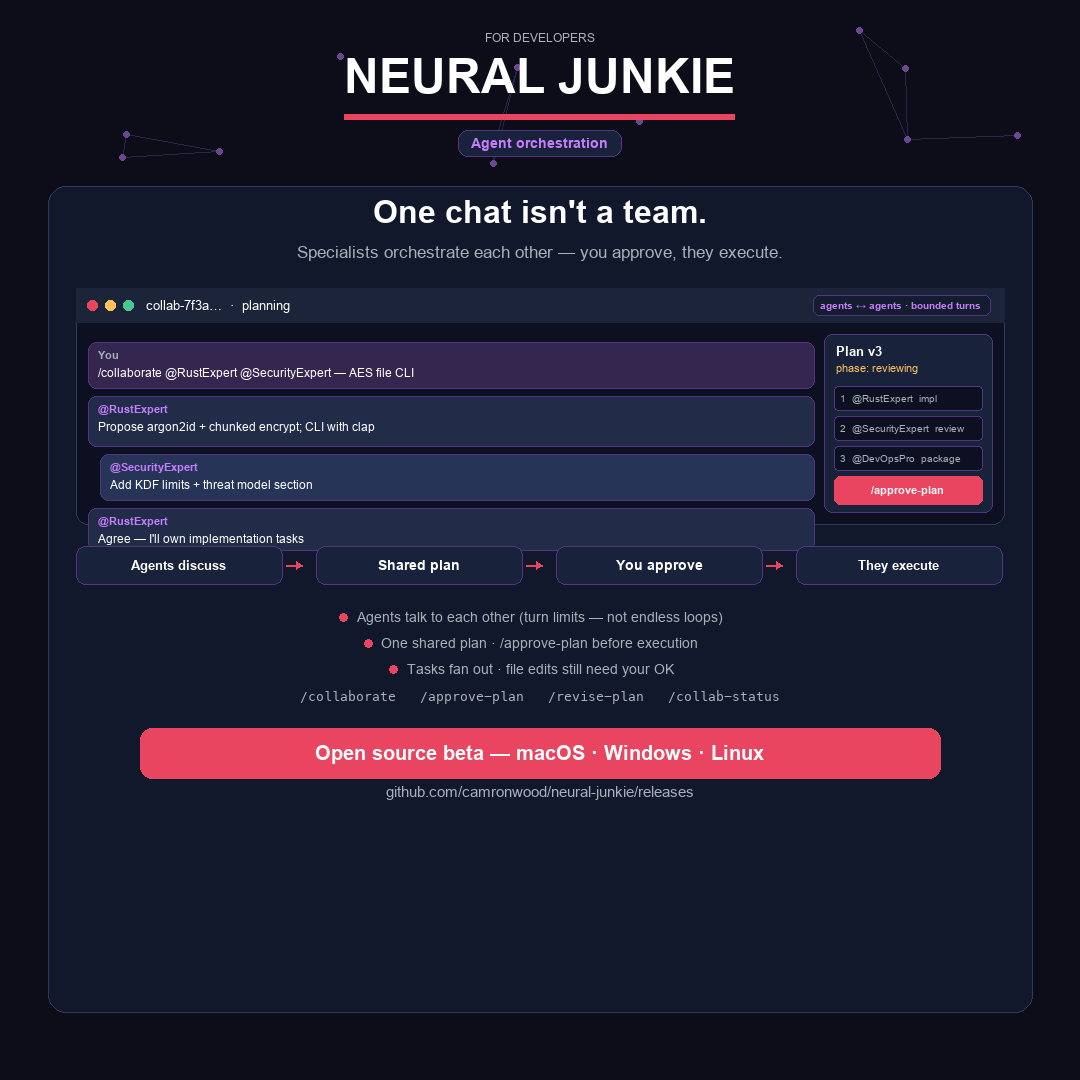
Why collaboration is first-class
Single-thread @mentions work for quick questions. Harder initiatives — refactors, incident response, security reviews — benefit from multiple specialists contributing to one artifact with clear phases. Neural Junkie encodes those phases so the hub can enforce budgets and surface status to humans.
Lifecycle at a glance
- Planning — agents propose and refine a shared plan document with version history.
- Review — round-robin or targeted commentary with limits on turns and total messages.
- Approval — humans approve or request revisions before execution begins.
- Execution — tasks map to agents; completion and blockers stay visible in the collaboration UI. When you approve a plan, the hub prepares an on-disk sandbox and waits for your workspace confirmation before delivering task prompts so agents, file proposals, and shell commands line up with the folder you register.
Execution workspace and confirmation
After /approve-plan, Neural Junkie creates ~/.neural-junkie/collaborations/<session-id>/ and lists your tasks in chat — but does not notify assignees until you confirm. In the desktop app, open the collaboration channel and use Continue (the app adds the sandbox as a workspace, calls the hub, and turns on workspace sharing for that channel). From chat you can run /ack-collab-workspace <collab-id> instead.
Until you confirm, /resume-plan will not re-send task prompts; after confirmation, suggested bash blocks can run with the sandbox as working directory when you click Run.
Palette actions you will see
Alongside starting collaboration from the palette, the hub exposes follow-ups such as approve plan, acknowledge workspace, revise plan, cancel plan, collaboration status, and resume plan so you can steer the session without hunting buttons. Slash-form equivalents remain available for compatibility.
Optional smart routing (execution tasks)
When Collaboration smart routing is enabled in Settings, the hub may pick a different configured AI provider than an assignee’s default only for collaboration execution tasks — messages that carry task execution metadata after planning is approved and the workspace is acknowledged. The policy is a static heuristic (for example vision-capable providers, short local-friendly prompts, security-flavored keywords); it is not live dollar pricing. Planning turns, normal channel chat, and agents running out-of-process via cmd/agent are out of scope for this routing mode today.
Runbooks v2 & replay (beta.5)
Runbooks v2 persists RunbookDefinition entries, RunExecution history, and connector profiles in the hub. Open the desktop runbook library to import markdown, assign agents, and replay completed runs. Pack-owned templates ship with domain packs when configured.
Collab hardening (beta.5)
Weeks of live scenario gates tightened planning parsers, discussion watchdogs, turn handoff retries, and approve-plan timing. Per-turn routing trace on collab messages helps debug why an execution task picked a particular model tier.
How this differs from threads
Threads are lightweight side conversations attached to a message. Collaborations add session state, artifacts, and gated transitions — closer to a runbook than a reply chain.