
Most multi-agent demos start when a human types.
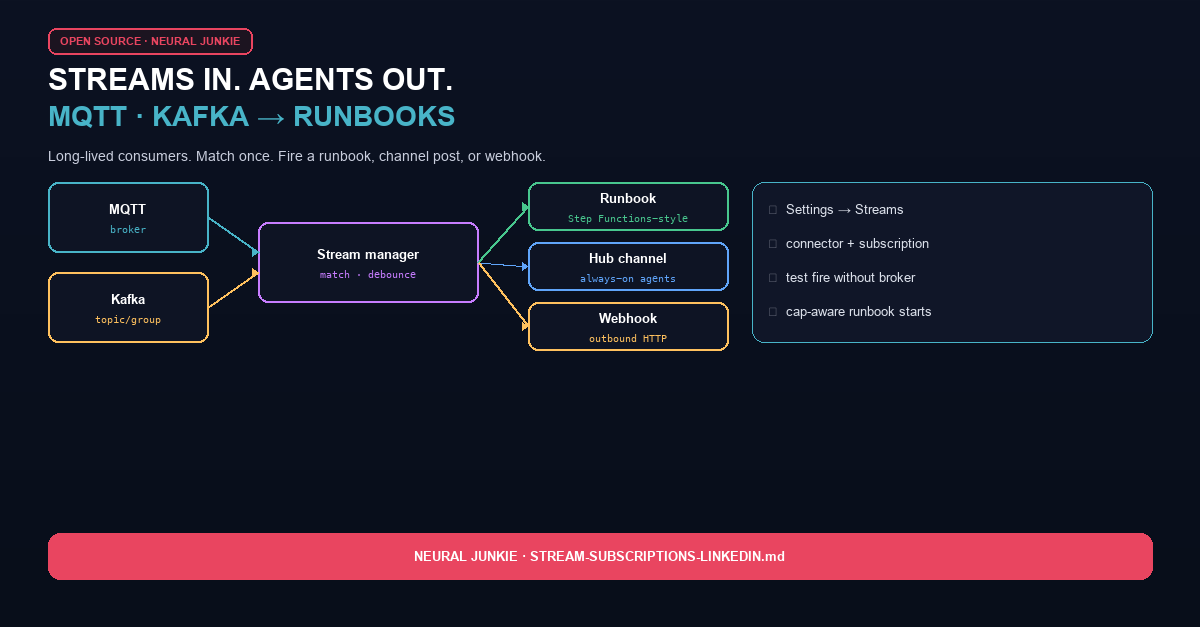
The real world often starts when a message arrives: a device telemetry spike on MQTT, an ops event on Kafka, an alert someone already publishes to a bus you run.
The wrong answer is to park an LLM on that topic and let it improvise forever.
The right shape is closer to AWS Step Functions: a long-lived consumer decides that something happened, then a finite workflow decides what to do.
That is what stream subscriptions add to Neural Junkie.
Two pieces (don't fuse them)
- Long-lived stream processor — stays connected to MQTT or Kafka, tracks offset/group membership, filters noise, debounces bursts.
- Action — what happens when a message is worth caring about:
- Runbook — start a saved SOP (agents + HTTP actions + approvals)
- Hub channel — post into a channel so always-on agents can react
- Webhook — forward to something else you already operate
Runbooks stay runbooks. Streams stay streams. The subscription is the binding between them.
Why not "just put an agent on Kafka"?
High-volume buses and generative agents are a bad couple:
- Agents are expensive and stateful; buses are chatty and idempotent
- You want offsets, retries, and consumer groups — not prompt cache
- You often need a human-shaped SOP (triage → investigate → notify), not a freeform chat loop
So the hub owns a small stream manager (same idea as our Slack Socket Mode bridge): start on boot, restart from Settings, one worker per enabled subscription.
What ships
Connectors for broker credentials (mqtt / kafka) — same encrypted connector store we use for webhooks.
Subscriptions saved under ~/.neural-junkie/stream/:
- Protocol + connector + topic
- Optional JSON field match (
statusequalsalert, orcontains) - Optional debounce window
- Action: runbook, channel, or webhook
Settings → Streams for status, CRUD, restart, and a Test button that injects a synthetic payload without a broker.
Docs: STREAM_SUBSCRIPTIONS.md
Runbook path (Step Functions style)
When the action is a runbook, the hub reuses the same path as POST /api/runbook-definitions/:id/trigger:
instantiate → submit → start
Inputs always include topic and payload (plus Kafka key). You can map JSON fields into named runbook inputs.
If you're already at the concurrent collaboration cap, we skip and surface the error on the subscription status instead of queueing an unbounded backlog. Honest beats silent.
Channel and webhook paths
Not every event deserves a full DAG.
- Channel posts as author
Streaminto a hub channel — mention an agent if you want a specialist to wake up. - Webhook POSTs outbound (connector auth optional) when another system should own the next hop.
Same matcher. Same manager. Different consequence.
The product bet
Local-first multi-agent work is not only chat UX.
It is an orchestrator that can sit next to the buses you already trust — device MQTT in the lab, Kafka in the platform — and still enforce human-visible workflows, approvals, and agent pools you control.
Streams in. Agents out — on purpose.
Try it
- Open Settings → Integrations and add an MQTT or Kafka connector.
- Open Settings → Streams, create a subscription, pick an action.
- Hit Test with a JSON payload, then point the connector at a real broker when you're ready.
Neural Junkie is open source. Download the latest release, or build from source, and wire your bus to a runbook instead of another zombie listener.