
Multi-agent collaboration is easy to demo and hard to justify.
You run /collaborate @SoftwareArchitect @BackendEngineer, get a planning thread, approve a plan, and watch tasks execute. It looks like a team. But teams have overhead — discussion budgets, plan parsing, approval gates, turn-taking rules. A single @BackendEngineer DM might finish the same job in half the time.
So when does multi-agent actually help?
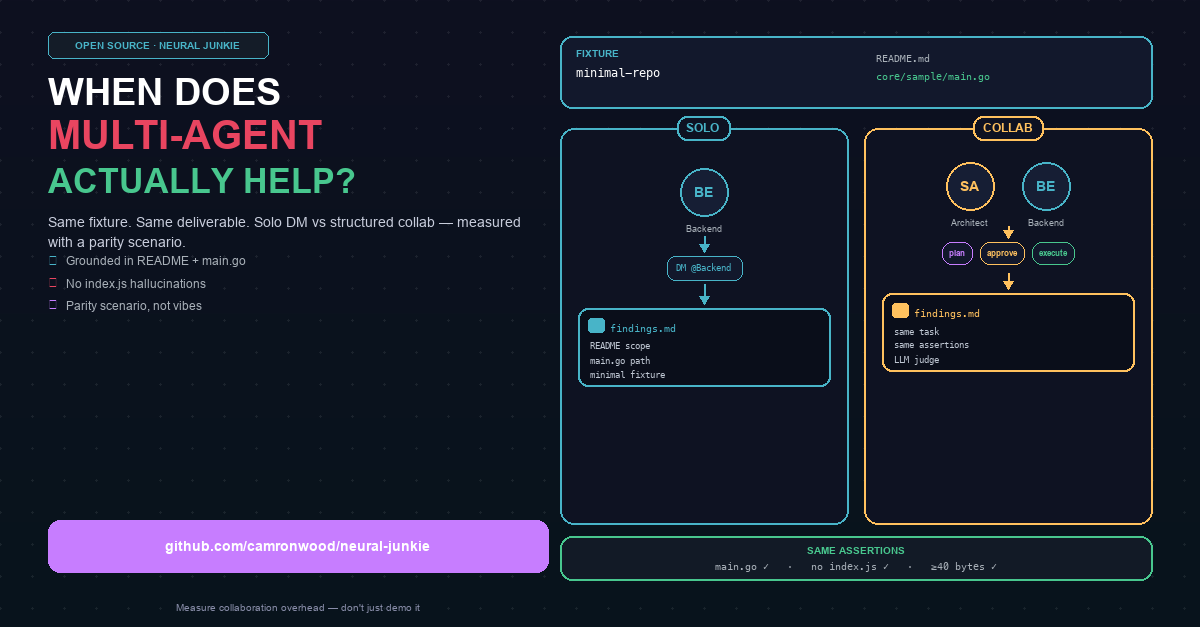
I got tired of arguing from screenshots. I built a parity scenario that runs the same deliverable two ways on the same fixture repo — and compares outcomes with the same assertions.
The question in one sentence
Does structured collaboration produce a better grounded deliverable than a solo specialist — or just more chat?
The setup
Fixture: minimal-repo — a tiny workspace with README.md and core/sample/main.go. Nothing else. No React boilerplate to hallucinate.
Task: write findings.md with three bullet findings about this repo only — grounded in README and main.go.
Two legs, same assertions:
| Leg | How | Channel | Agents |
|---|---|---|---|
| Solo | DM @BackendEngineer directly |
collab-scenarios-solo |
BackendEngineer |
| Collab | /collaborate with planning → approve → execute |
collab-scenarios |
BackendEngineer + SoftwareArchitect |
The collab goal is intentionally minimal — one task, one owner:
@BackendEngineer Plan one task: @BackendEngineer writes collabs/<collab-id>/findings.md
with three bullet findings about this repo (README.md and core/sample/main.go only).
Bounded: --rounds 1 --messages 3. We're not testing infinite planning theater. We're testing whether the collab pipeline can land the same file a solo DM would.
What we assert (both legs)
Hard checks, not vibes:
findings.mdexists with ≥ 40 bytes- Content references
main.go,core/sample, orminimal - Content does not hallucinate
index.js,utils.js,app.js, or generic "data handling module" boilerplate - LLM judge on collab leg: "PASS if findings summarize this minimal-repo fixture. FAIL for hallucinated paths."
This is the failure mode that hurts most in production — agents that sound confident while writing about files that don't exist in your workspace.
Why parity, not just collab regression
Collab regression scenarios answer: "Does the pipeline work?" — phases advance, tasks complete, files land on disk.
Parity scenarios answer: "Is collab worth the overhead for this class of work?"
If solo passes and collab fails → the pipeline is the problem (plan parsing, workspace binding, execution dispatch).
If both fail the same way → the specialist or workspace context is the problem, not multi-agent orchestration.
If collab passes and solo fails → rare, but interesting — structured planning might help grounding.
If both pass → collab isn't worse for this task. Whether it's better depends on whether architect input improved the findings — the judge catches qualitative gaps the regex assertions miss.
What we've learned so far
Early runs surfaced real platform issues, not scenario bugs:
Solo leg failures often mean workspace binding — the agent describes the Neural Junkie desktop repo instead of the scenario fixture. That's a context injection problem, not "BackendEngineer can't write markdown."
Collab leg failures cluster differently:
- Plan parsing —
assert_planfinds 0 tasks or too many (parser explosion on prose-heavy plans) - Execution stalls —
wait_taskstimeouts after planning looked fine - Participation gaps —
@BackendEngineersilent during planning while architect talks - Generation errors — Ollama HTTP timeout before discussion budget completes (we fixed one class by raising client timeout from 360s → 540s)
solo-vs-collab-parity failed on the solo leg in a recent collab-full fix-loop iteration — while planning-participation scenarios improved after the timeout fix. That's exactly the signal parity is designed to produce: don't assume collab is the bottleneck.
When multi-agent is worth it (and when it isn't)
Worth it when:
- Tasks have real dependencies across specialists (security review before implementation)
- Planning quality matters — architect shapes scope before execution burns tokens
- You need audit trail — phases, approvals, task graph on disk
- The deliverable benefits from cross-domain synthesis
Probably not worth it when:
- One specialist owns the entire task end-to-end
- The "collab" is really one agent with an audience
- Planning overhead exceeds execution time
- Workspace context is already clear and bounded
The parity scenario uses the minimal case on purpose. If collab can't match solo here, it won't magically excel on harder work without fixing the pipeline first.
How it fits the test harness
solo-vs-collab-parity lives in scenarios/collab/ and runs as part of make layer-gate LAYER=collab-full. It's Layer 3 of the conversational harness — live JSON scenarios with real Ollama agents.
It composes with release engineering loops:
make layer-gate LAYER=collab-full
make layer-fix-loop LAYER=collab-full
When parity fails, the fix-loop brief includes targeted rerun commands for both legs. No weakening assertions to greenwash — if solo passes and collab doesn't, the hub has work to do.
The scenario shape (simplified)
{
  "name": "solo-vs-collab-parity",
  "workspace": { "fixture": "minimal-repo" },
  "solo_leg": {
    "message": "@BackendEngineer Create collabs/parity-solo/findings.md …",
    "any_match": ["main\\.go", "core/sample"],
    "none_match": ["index\\.js", "utils\\.js"]
  },
  "collaborate": {
    "goal": "@BackendEngineer Plan one task: …",
    "flags": ["--workspace", "--rounds", "1", "--messages", "3"]
  },
  "expect_deliverables": [
    { "path": "collabs/<collab-id>/findings.md", "llm_judge": { … } }
  ]
}
Full scenario: scenarios/collab/solo-vs-collab-parity.json
What we didn't try to solve
- Proving collab is always better — parity measures equivalence and grounding, not creativity scores
- Subjective "was the architect's input valuable?" — the judge catches hallucination; human review catches insight
- Every task type — this is one deliverable class. Website builds and security refactors need their own parity scenarios
The bet: measure collaboration overhead instead of demoing it.
Try it
make collab-scenario SCENARIO=solo-vs-collab-parity
make layer-gate LAYER=collab-full
Docs: COLLABORATION.md · TESTING.md
Download: https://camronwood.github.io/neural-junkie/download.html
Neural Junkie is a personal open-source project. Feedback and scenario failures welcome on GitHub.