
You tell the agent: “Something is wrong — the application exits before showing its interface. Diagnose it and sort it out.”
Or: “Create a Neural Canvas beside this conversation that explains the architecture.”
Or: “Proceed with that.”
Three different meanings. Three different actions. Same messy language.
For a long time, Neural Junkie tried to catch those meanings with distributed phrase lists — on the desktop, in the agent, in knowledge routing, in trust signals, in implementation gates. Boot-fix regexes. Canvas detectors. Continuation affirmations. Code-review cues.
It worked until it didn’t.
“Will not boot” and “Neural Canvas” became the poster children: hard-coded phrases that misrouted turns, fought each other, and couldn’t survive a paraphrase. Every new product surface meant another list to keep in sync.
So we replaced the lists with a single rule:
Resolve meaning once. Compile policy once. Stamp an immutable turn decision. Consume it everywhere.
The bet in one sentence
The model describes requested meaning. Deterministic policy grants permission.
A local classifier never gets to authorize writes, frontier access, destructive ops, or auto-apply. Those stay in code you can audit.
What broke
Phrase matching fails in predictable ways:
- Paraphrase blindness — “won’t start,” “never reaches the UI,” and “exits before the interface” are the same job; regexes only catch the phrases you remembered to write
- Homonym collisions — “canvas” as a durable chat artifact vs an HTML canvas component in source
- Split brain — desktop picks an agent, server re-infers action, knowledge router rescans the raw text, trust layer runs its own regexes
- Unsafe authority creep — if a phrase list can flip
implementation_session, a clever wording can ask for more power than the UI mode allowed
We didn’t need a smarter regex. We needed a typed contract.
One typed decision per turn
At hub ingress — after mentions and DMs are handled — Neural Junkie now builds bounded TurnFeatures and resolves a versioned TurnDecision:
- Interaction — question, task, continuation, correction, closure, casual
- Action — answer, inspect, plan, debug, edit, run, continue, artifact, image, ask-user
- Domain / recipient — which specialist should own the turn when nobody was @mentioned
- Retrieval — memory, codebase, graph, prior reference, collab artifact
- Mutation — none, external, or workspace
- Provenance — structural directive, local classifier, or safe fallback
That decision is stamped on the message. Client-authored decisions are stripped. The turn pipeline, knowledge plan, model routing, trust classification, artifact/image gates, and implementation session all prefer the stamp over re-reading the user’s sentence.
How resolution works
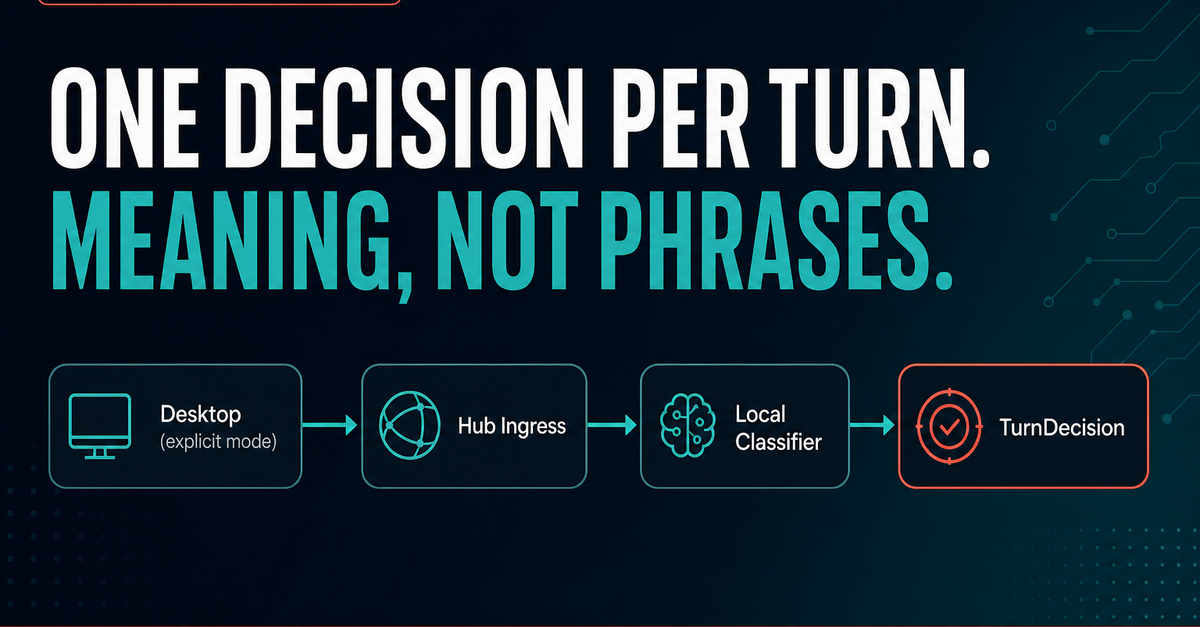
Desktop → explicit composer mode, trust, IDE context, mentions, reply IDs
    ↓
Hub ingress → structural features
    ↓
Fully determined? ──yes──► Deterministic policy
    │
    no (semantic ambiguity)
    ↓
Local structured classifier (utility model, temp 0, JSON schema)
    ↓
Deterministic policy → TurnDecision
    ↓
Recipient · TurnGoal · KnowledgePlan · model route · evidence contract
Structural facts still win without calling a model: Ask/Plan/Export mode, slash commands, explicit mentions, typed reply/action IDs, pending continuation targets, workspace presence, and capability flags.
When the text is ambiguous, a local utility model classifies into the schema. One repair attempt on malformed JSON. Low confidence abstains into a safe fallback. Frontier models are never used for turn classification.
Policy owns the dangerous bits
Examples that matter in practice:
- Ask and Plan force
mutation: noneeven if the classifier suggests edit - Workspace mutation requires both capability flags and an actual workspace
- Debug / edit / run / continue with a workspace get codebase retrieval without re-scanning for “look in the repo”
- Continuation needs a durable pending action ID — “go ahead” alone is not enough to invent one
The classifier can say what the user asked for. Policy decides what the runtime is allowed to do.
Desktop becomes a thin client
The send path no longer invents implementation sessions from “please implement…” or routes boot fixes to FrontendEngineer because a phrase matched.
It transports:
- Composer mode and trust preference
- Active editor / workspace context
- Attachments and
@codebasesyntax - Explicit mentions and reply/action IDs
- A versioned
turn_governanceenvelope with explicit provenance
Semantic authority lives on the server. That matches the hub thesis from the earlier architecture article: orchestration belongs in a server you control.
What we kept (and what we quarantined)
We kept narrow deterministic recognizers for syntax and safety: slash commands, mentions, paths, structured diagnostics, destructive command checks, and evidence-claim validation.
Legacy phrase lists still exist behind an emergency rollback flag and as fallbacks when no decision is stamped. A repository guard test fails if new semantic phrase regexes appear outside the classifier package or the explicit quarantine list.
Direct cutover — no shadow dual-run of live turns. Telemetry records schema version, source, classifier model, latency, confidence, abstention, and policy overrides without stuffing extra raw user text into the log.
Try the idea in one sentence
If two wordings mean the same job, they should produce the same TurnDecision.
If a wording sounds like a write but Ask mode is on, policy must still refuse the write.
That’s the upgrade: meaning over phrases, policy over vibes.