
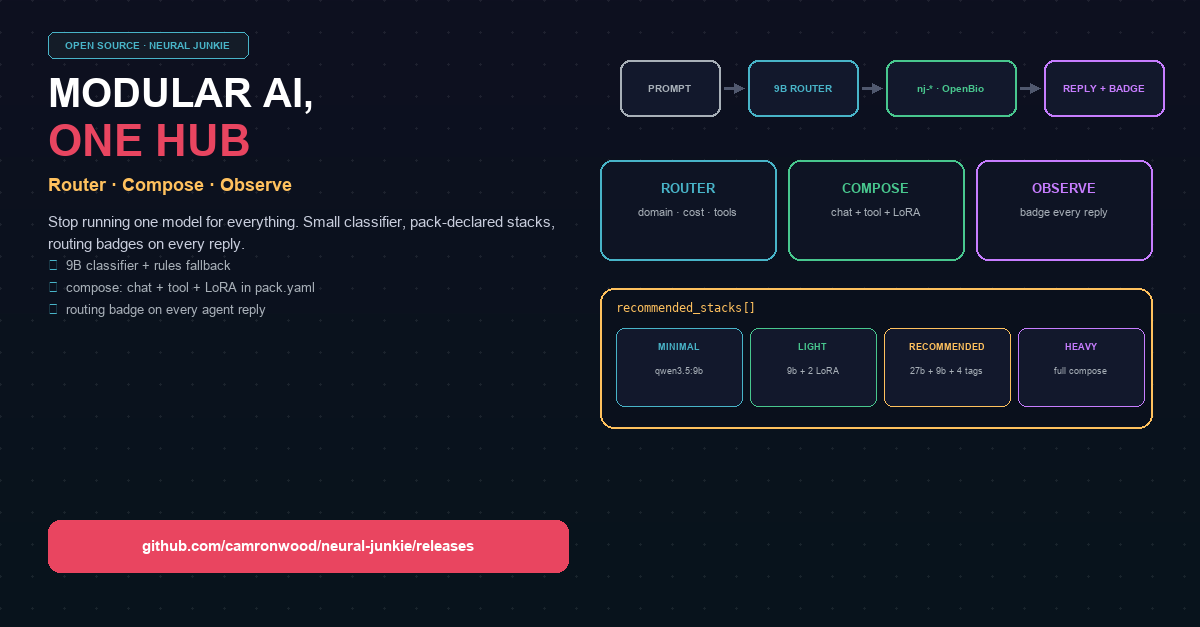
The industry is converging on modular AI: router + small specialists, LoRA adapters, mixture-of-experts inside foundation models. The goal is the same — don't run a 70B jack-of-all-trades for every token.
Neural Junkie takes that idea one layer up: orchestration-layer composition. You still talk to one specialist. The hub decides which model runs, which tools fire, and which LoRA tag applies — then shows you the answer on the message itself.
This builds on our earlier model layering article. That piece covered context, weights, routing, and orchestration. This one ships the next layer: unified routing, pack-declared compose stacks, and observability you can trust.
The problem with one model
One 14B (or 27B) model cannot be your security reviewer, biology expert, session summarizer, typo-fixer, and tool-runner — not on a 16 GB laptop, and not without quality tradeoffs.
Keyword heuristics help (looksSecurity, looksCheap) but they drift, miss edge cases, and never tell the user what actually ran. Modular AI only feels real when routing is legible.
Pillar 1: A small classifier router (not a 70B gatekeeper)
Neural Junkie now classifies each collab task and delegation consult through a unified router (internal/routing):
- LLM default:
qwen3.5:9breturns structured JSON —domain,tool_need,cost_tier,confidence,reason - Rules fallback: consolidated keyword lists when the LLM fails, times out, or confidence drops below 0.6
- Table-tested: 80+ deterministic cases mirror the chat quality router harness
A security collab task routes to nj-security:14b when installed. A typo-fix routes to the cheap local tier. Biology tool questions trigger tool_need without you @mentioning BiologyExpert.
Debug when NEURAL_JUNKIE_DEBUG=1:
curl 'http://localhost:18765/api/debug/routing-classify?q=review+JWT+auth+flow&agent_type=security'
Pillar 2: Composed specialists in every pack
BiologyExpert was always split-brain: OpenBio for reasoning, Qwen 9B for MCP tools. That pattern is now a first-class pack compose template:
compose:
  chat_model: koesn/llama3-openbiollm-8b:latest
  tool_model: qwen3.5:9b
  lora_tag: nj-biology:8b
  consult_triggers: [biology, protein, sequence]
Life sciences and software development packs ship compose blocks today. Security gets nj-security:14b + tool model. The hub resolves chat/tool/LoRA through one code path for DM, collab, and implementation sessions — no more biology-only if branches.
Pillar 3: See which model ran
Every agent response can carry routing metadata:
routing_model— chat model tagrouting_tool_model— tool loop when fallback firedrouting_reason— e.g.security_lora_local,cheap_localrouting_source—llmorrules
The desktop shows a compact badge on each reply (nj-security:14b · llm). Tooltip shows the full chain. Toggle in Settings → Layout → Routing badges on messages.
Modular AI without observability is just vibes. This makes it auditable.
Pillar 4: Recommended stacks per RAM tier
Two-tier strategy stays: Qwen for inference, Llama/Mistral bases for LoRA compose. But the docs and API now spell out full stacks:
| Tier | Inference | LoRA (optional) | Disk |
|---|---|---|---|
| minimal | qwen3.5:9b + cloud |
none | ~10 GB |
| light | qwen3.5:9b |
1 base + 1 tag | ~15 GB |
| recommended | qwen3.5:27b + qwen3.5:9b |
3 bases + 4 bootstrap tags | ~35 GB |
| heavy | above + OpenBio | full specialist-tuning | ~50+ GB |
GET /api/system/hardware returns recommended_stacks[] — same data the wizard and Pack Store can render.
Walkthrough: verify it yourself
1. Security collab task
Run /collaborate with a security review task. After approval, the task message and agent reply should show nj-security:14b when the tag is installed.
2. Biology DM
DM BiologyExpert: "What's the difference between scan summary and scan analysis?" → OpenBio chat, no tool loop.
Then: "Analyze this peptide: MKTAYIAKQRQISFVKSHFSRQ" → Qwen tool loop, PDB path in reply. Badge shows both models.
3. Typo task
Ask BackendEngineer to "fix typo in README" in collab execution. Router picks cost_tier: cheap → local utility tier.
What we learned
1. Orchestration-layer MoE beats model-layer MoE for local-first products.
You don't need to train a gating network inside a foundation model. Route at the hub with specialists you control.
2. Observability is a feature, not debug logging.
[collab-routing] logs are not enough. Users need badges.
3. Packs should declare composition, not hardcode biology.
compose: in pack.yaml is the contract. LoRA adapters and chat/tool splits are pack concerns.
4. Test the router in code.
Models change weekly. Deterministic routing tests + live collab scenarios catch regressions without guessing from the UI.
Try it
Personal open-source project — macOS, Windows, Linux.
make pull-models
make start-all
Download: https://github.com/camronwood/neural-junkie/releases/latest
Docs:
- Context model
- Hardware tiers + stacks
- LoRA adapters
- Delegation
If routing sends a security task to the wrong tier — or a badge shows the wrong model — GitHub issues welcome. That feedback becomes the next scenario in the harness.
Camron Wood — Neural Junkie (personal project)