
Most multi-agent demos look impressive until you ask a simple question: which model is actually running, and why?
If the answer is "the same one for everything," you pay for it — in RAM, latency, hallucinated tool calls on "thanks," and security reviews that read like generic chat.
Neural Junkie is a personal open-source desktop hub where you run AI specialists on your hardware — security reviewers, architects, repo experts, biology specialists — under your control. The product bet isn't one perfect model. It's layering different models at the right level so each turn gets the right brain, the right context, and the right cost.
Here's how we stack them.
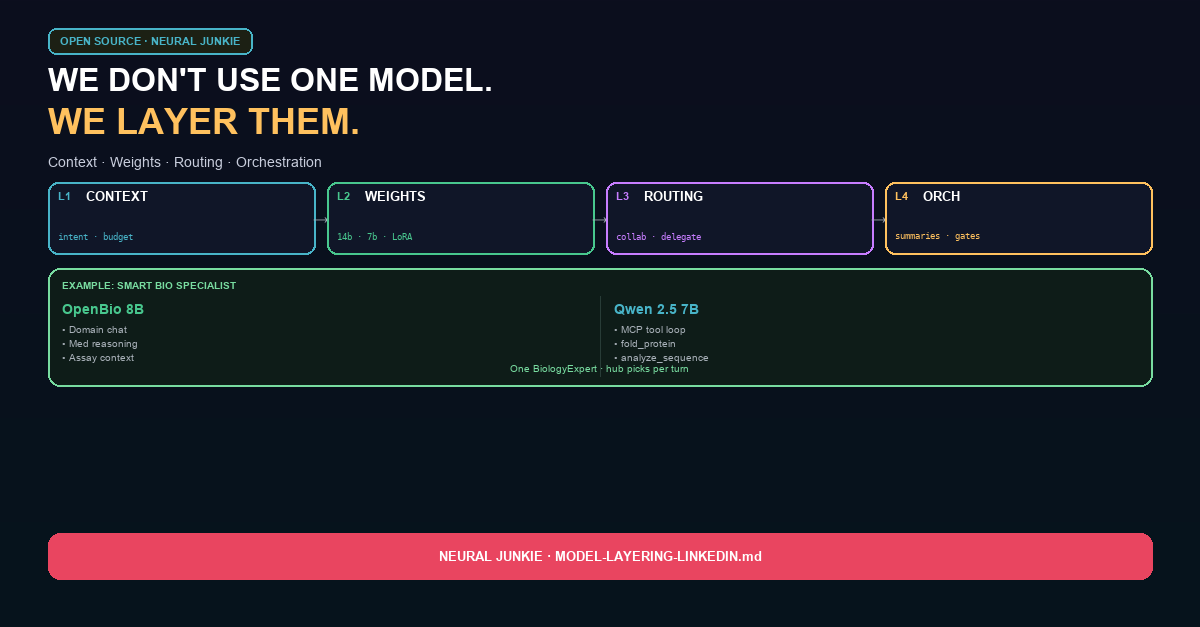
The four layers (at a glance)
Every user turn flows through a stack before you see a reply:
- Context — decide how much model you need (mode, intent, memory, budget)
- Weights — decide which model tag (14B coder, 7B utility, LoRA tags, domain models)
- Routing — decide which provider per job (collab tasks, implementation, delegation)
- Orchestration — multi-model flows that still feel like one product
Same hub. Same UI. Different model decisions at each stage.
Layer 1: Context — decide how much model you need
Before any LLM call, every user turn passes through a Conversation Context Stack:
- Mode — chat, code, or collaboration (from the composer or auto-detected signals)
- Intent — closure, casual, substantive, or task
- Memory — rolling session summary + capped history
- Grounding — workspace scan only when you're actually coding
- Persona — DM vs channel vs collab framing
- Budget — byte caps so prompts don't blow context windows
This layer often avoids a model call entirely.
"Thanks!" → canned closure reply. No 14B inference. No tool dump. No workspace scan.
A casual DM → minimal prompt with 2 history rows and a lightweight utility summary — not the full MCP + file-change block you'd send for a refactor task.
The insight: routing context is cheaper and more reliable than asking a big model to "behave appropriately" every turn.
Layer 2: Weights — decide which model tag
Once we know the turn deserves a real inference, we pick the weight layer:
| Role | Default model | Why |
|---|---|---|
| Software specialists | qwen2.5-coder:14b |
Strong code, tools, implementation loops |
| Utility / background | qwen2.5:7b |
Session summaries, moderator, assistant |
| Domain chat (biology) | koesn/llama3-openbiollm-8b |
Med/science-tuned weights |
| LoRA specialists | nj-security:14b, nj-biology:8b, … |
Composed tags — tens of MB, not tens of GB |
Two-tier LoRA strategy
We wanted one Qwen base + tiny LoRA adapters for every role. Ollama's safetensors ADAPTER path supports Llama, Mistral, and Gemma — not Qwen.
So we split:
- Inference tier: Qwen stays the default for day-to-day specialist chat and tools
- LoRA tier: train and compose on Llama/Mistral bases, assign composed tags when you want domain-tuned weights
Prompt personas and the context stack stay the same. LoRA adjusts the layer underneath.
MCP vs LoRA (knowledge vs behavior)
Two more mechanisms at different layers:
- MCP export — portable knowledge (indexed repo context, prompts, architecture notes)
- LoRA — portable behavior (weight adapters that lean inference toward your domain)
Same repo expert can export context for teammates and train a local adapter from session history. Complementary, not interchangeable.
Layer 3: Routing — decide which provider per job
Per-agent defaults aren't enough. Some jobs need different models than the agent's default chat tag.
Collaboration smart routing
When agents execute tasks after you approve a plan, the hub can route per task:
- Security keywords → local
nj-security:14bif installed, else premium cloud provider - Short wording/typo tasks → cheapest local tier
- User images + vision → lowest-cost provider that supports vision
Normal chat and per-agent defaults are unchanged. Routing kicks in for collaboration execution tasks — the work that would otherwise burn your best model on "fix this typo."
Implementation sessions (local-first)
Implementation mode prefers local Ollama first for tool loops, with a smaller tool model (qwen2.5-coder:7b) when configured. Cloud providers are fallbacks — not the default path for every file edit.
Agent delegation (consult, don't hand off)
When delegation is enabled, a responding agent can silently consult other specialists:
- Hub scores relevance across registered experts
- Up to 2 consultants run in-process (no public handoff)
- Results inject as
=== DELEGATE_RESULTS === - The responding agent's model synthesizes one reply
Delegation is skipped for closure and casual intents — greetings shouldn't trigger a biology consult.
For biology specifically, we split further:
- Domain reasoning → OpenBio chat model
- Domain tools (MCP sequence/fold tools) → specialist runtime +
qwen2.5:7btool loop when the chat model lacks native tool support
One user-facing answer. Multiple models under the hood. By design.
Example: OpenBio + Qwen = one smart biology specialist
The life-sciences pack is the clearest example of layering models on purpose instead of picking one "bio model" and hoping it does everything.
The constraint
OpenBioLLM (koesn/llama3-openbiollm-8b:latest) is strong at biomedical reasoning — pathways, assay context, sequence interpretation in plain language. But in Ollama it does not expose native tool calling.
BiologyExpert still needs real tools:
analyze_sequence— validate DNA/RNA/protein, length, reverse complementfold_protein— ESMFold via Hugging Face → PDB on disksummarize_scan_summary/summarize_scan_analysis— plate QC from Phoenix-style exportsrun_12plex_qc— SOP pass/fail per analyte
You can't drop OpenBio and call it done. You also can't swap in Qwen 14B for everything — you lose domain-tuned weights and burn RAM on chat that doesn't need it.
The split: domain brain + tool hands
| Job | Model | Why |
|---|---|---|
| Chat / reasoning | OpenBio 8B | Med/science-tuned weights; natural explanations |
| MCP tool loop | qwen2.5:7b |
Native Ollama tool calling; small footprint (~4.5 GB) |
| Empty-reply safety net | qwen2.5:7b |
Fallback if OpenBio returns an empty stream |
Same Ollama endpoint. Same BiologyExpert persona. Different model per layer of the turn.
From the user's side: one DM with BiologyExpert. Under the hood: OpenBio for fluency, Qwen for execution.
Walkthrough: two messages, two models
Message 1 — pure reasoning (OpenBio)
"What's the difference between a scan summary and a scan analysis export in our Phoenix workflow?"
No MCP tools required. The hub streams through OpenBio. You get domain-aware language without spinning up a 14B coder or a tool loop.
Message 2 — tools required (Qwen orchestrates)
"Here's a peptide: MKTAYIAKQRQISFVKSHFSRQ. Analyze it and fold the structure."
BiologyExpert has MCP tools registered. The hub sees the chat model lacks native tool support and routes the tool loop through qwen2.5:7b on the same Ollama host:
- Qwen calls
analyze_sequence→ length, composition, validation - Qwen calls
fold_protein(HF token from Settings) → PDB under~/.neural-junkie/bio/ - Qwen synthesizes one reply with paths and interpretation
OpenBio didn't need to pretend it could call tools. Qwen didn't need to pretend it was fine-tuned on MedMCQA. Each model does what it's good at.
Delegation: any agent can borrow the stack
With agent delegation enabled, you don't have to DM BiologyExpert directly.
Ask BackendEngineer in a mixed channel:
"We're adding a new analyte to the 12-plex — any QC gotchas from a biology perspective?"
The hub scores consultants, picks BiologyExpert, and classifies intent:
| Intent | What runs |
|---|---|
domain_reasoning |
OpenBio via model consult — concise internal answer |
domain_tools |
BiologyExpert runtime + Qwen tool loop if the question needs run_12plex_qc or scan summaries |
Results inject as === DELEGATE_RESULTS ===. BackendEngineer's model merges them into one reply. You still talk to one agent; the biology stack runs silently underneath.
Config (optional overrides in ~/.neural-junkie/config.json):
"delegation": {
  "enabled": true,
  "biology_chat_model": "koesn/llama3-openbiollm-8b:latest",
  "biology_tool_model": "qwen2.5:7b"
}
Optional third layer: LoRA weights
Want local biology behavior baked into weights, not just prompts?
nj-biology:8b— LoRA compose onllama3:8b+ MedMCQA adapter (Specialist tuning pack)nj-bio:8b— full OpenBio GGUF import with Llama 3 chat template
Same hub routing: if the assigned tag lacks native tools, Qwen still runs the tool loop. LoRA adjusts the chat layer; it doesn't replace the orchestration.
Why this pattern generalizes
Biology is the template for how we think about layering elsewhere:
- Don't force one model to be expert + tool-runner + summarizer.
- Use domain weights where they matter (OpenBio for reasoning).
- Use a small, tool-capable model where reliability matters (Qwen 7b for MCP).
- Let the hub pick per turn — not the user memorizing which tag to
@mention.
That's what "smart bio model" means in Neural Junkie: not a single merged checkpoint, but a composed specialist — the right models, wired together, one coherent answer.
Pull both models:
ollama pull koesn/llama3-openbiollm-8b:latest
ollama pull qwen2.5:7b
Enable Life sciences in Settings → Domain packs, DM BiologyExpert, and try the two-message walkthrough above.
Layer 4: Orchestration — multi-model flows that still feel like one product
The hardest layer isn't picking a tag. It's making multi-model orchestration feel coherent:
Session summaries run asynchronously on qwen2.5:7b every few user turns — keeping long DM threads coherent without re-sending full transcripts to the 14B specialist every time.
Collaboration uses bounded phases, task DAGs, workspace gates, and file approvals. Models improvise; the hub enforces gates. Chat markdown doesn't write to disk — structured file proposals do, after your approval.
Cross-provider BYOM lets you mix Ollama, Anthropic, OpenAI-compatible, and CLI-backed providers. Smart routing picks among your configured providers — not a hardcoded cloud default.
The product promise: you talk to one specialist; the system layers models so that specialist has the right context, the right weights, and the right consults — without you managing the stack manually.
What we learned building this
1. One model is a demo. Layering is a product.
Specialists need different weights. Background tasks need smaller models. Tool loops sometimes need a different tag than chat. Collab tasks need per-task routing. Pretending one 14B does all of it wastes RAM and produces worse UX.
2. Context routing beats prompt engineering for the easy cases.
Don't send MCP tools and workspace scans on "hey." Classify intent first. Save the big model for substantive work.
3. Orthogonal layers compose.
LoRA doesn't replace MCP export. Smart routing doesn't replace per-agent defaults. Delegation doesn't replace collaboration orchestration. Each layer solves one constraint.
4. Local-first, cloud when it earns its keep.
We default to Ollama for specialists and tool loops. Cloud providers are configured fallbacks and premium paths for high-stakes tasks — not the only way to run the hub.
5. Test the orchestrator in code; test the conversation in scenarios.
Models change weekly. Deterministic tests cover phase transitions, DAG readiness, and routing heuristics. Live JSON scenarios cover "did the security task actually prefer the LoRA tag?" without guessing from the UI.
Try it
Personal open-source project — macOS, Windows, Linux.
make pull-models   # qwen2.5-coder:14b + qwen2.5:7b + LoRA bases
make start-all
Download: https://github.com/camronwood/neural-junkie/releases/latest
Docs:
- Context model
- LoRA adapters
- Biology pack
- Delegation
- Collaboration
If you run a multi-model setup and hit a routing edge case — wrong model on a collab task, delegation firing on small talk, LoRA compose failing — GitHub issues welcome. That feedback becomes the next scenario in the harness.
Next: Modular AI composition — unified router, pack compose templates, routing badges, and per-tier stacks.
Camron Wood — Neural Junkie (personal project)