
If you've shipped an agent that can run shell commands, you've probably hit this wall:
The agent runs make start-all. It fails. It runs it again. And again. Chat fills with command_output messages, but nothing on disk changes and sometimes there's no final summary at all.
That's not a model intelligence problem alone. It's a missing closed loop.
I've been building Neural Junkie as a local-first open-source agent hub — specialists in chat, IDE Agent mode, and multi-agent collaboration. Agent Runtime v2 gives specialists long native tool loops. Great for reach. Dangerous without platform policy.
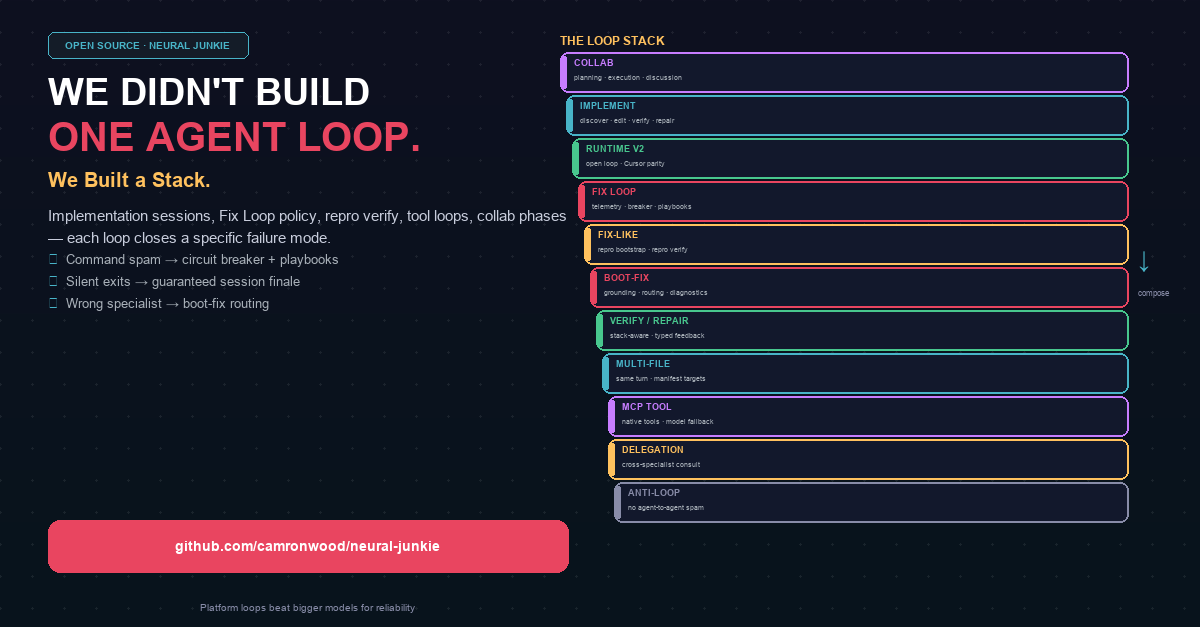
This article is the map: the loop stack — every named loop in the product, what problem it solves, and why we didn't try to solve everything with one monolithic planner.
The bet in one sentence
Platform loops beat bigger models for reliability.
Models improvise. Loops enforce outcomes: read before you run, edit before you retry, verify before you claim success, and always report what happened.
The stack at a glance
Not every "loop" in Neural Junkie is the same kind of thing. Some are user-facing workflows. Some are policy layers. Some are inference mechanics. Some are guardrails.
flowchart TB
    subgraph Collab["Collaboration loops"]
        CP["Planning loop"]
        CE["Execution loop"]
        CD["Discussion loop"]
    end

    subgraph Product["Product loops"]
        IS["Implementation session"]
        ARv2["Agent Runtime v2 open loop"]
        MF["Multi-file continue"]
    end

    subgraph Fix["Fix Loop policy"]
        FL["Fix-like / repro"]
        BF["Boot-fix"]
        VR["Verify / repair"]
    end

    subgraph Inference["Per-turn inference"]
        TL["MCP tool loop"]
        DC["Delegation consult"]
    end

    subgraph Guard["Guardrails"]
        AL["Anti-loop guard"]
    end

    CP --> CE --> IS
    IS --> FL
    FL --> BF
    IS --> VR
    IS --> MF
    IS --> TL
    TL --> DC
    CD --> AL
Same hub. Same desktop. Different loops for different failure modes.
Layer 1 — Implementation session loop
Problem: A single tool-call turn isn't enough to implement a feature. The model needs to explore the repo, propose edits, and confirm the workspace still builds — without the user saying "go ahead" after every file.
What we built: A bounded implementation session: discover → edit → apply → verify → repair.
Why bounded: Unbounded agent loops look impressive in demos and expensive in production. Phase 1 caps (~20 tool iterations, 3 edit rounds) gave us a testable contract. Agent Runtime v2 raises those caps for Cursor parity, but the shape stays the same.
Triggers: IDE Agent mode, implementation_session: true, or team-channel implement metadata when the dev pack and workspace are active.
Outcome metadata: Every session posts implementation_session_outcome — files changed, verify status, repair used — so scenario harnesses and users get a definitive answer, not silence.
Docs: IMPLEMENTATION_SESSION.md
Layer 2 — Agent Runtime v2 (open loop)
Problem: Cursor-like parity needs coordinated multi-file refactors and long repair chains without the user nudging between files. Bounded Phase 1 caps were right for acceptance testing; they were too tight for real refactors.
What we built: Agent Runtime v2 — same discover → edit → verify → repair phases, but with open-loop guardrails: up to 100 tool steps, 5 repair rounds, 50 files per cycle, 60-minute wall clock.
Why separate from Phase 1: We wanted a feature flag (features.agent_runtime_v2) and parity scenarios (long-agent-loop-repair, multi-file-refactor-10) without breaking the 20/20 implement gate that ships releases.
Key insight: Open loop is not "no policy." It's "higher caps with the same phase machine."
Layer 3 — NJ Fix Loop (platform policy)
Problem: In a real boot-fix session we saw make start-all fail 8×, 11 command_output posts, zero file edits, and no session wrap-up. The outer implementation session only advanced on file proposals and verify. Tool-step observers tracked discover tools, not run_command failures.
My agent can execute ≠ my agent can fix my app.
What we built: Fix Loop — platform-owned policy on top of the tool loop:
| Mechanism | Why |
|---|---|
| Command telemetry | Every run_command recorded in session state |
| Circuit breaker | Same failing command twice without read/edit → third run blocked at MCP layer |
| Boot-fix grounding | make start-all / npm run dev blocked until Makefile, package.json, or startup scripts were read |
| Deterministic playbooks | Known signatures (e.g. missing start-all target) trigger Makefile repairs before model guessing |
| Session finale | Every session ends with summary + outcome metadata — command thrashing can't exit silently |
| Routing | Boot-fix signals route to FrontendEngineer, not SoftwareArchitect |
Why a policy layer, not a new runtime: The phase machine was already correct. What was missing was forcing read → edit → re-run when commands failed. That's hub policy, not a bigger model.
Proof scenario: make implement-scenario SCENARIO=tauri-make-start-all-missing
Layer 4 — Fix-like and repro loops
Problem: "Something's broken" and "add dark mode" both look like implementation requests. Feature builds need discovery and multi-file edits. Bug fixes need reproduction first — run the failing command, capture output, fix the root cause, re-run.
What we built: FixLikeIntent detection. When the message looks like repair (errors pasted, "won't boot", "not working") rather than greenfield feature work:
- Infer a repro command (
go test ./...,npm run build,make start-all, …) - Run it once in repro bootstrap
- Apply playbooks if output matches known signatures
- Repro verify — re-run the same command after edits
Why separate from generic implement: Without repro targeting, agents optimize for plausible edits instead of closing the failure you actually reported. The verify loop for a theme toggle is npm run build. The verify loop for a failing test is that exact test command.
Clarification gate: Vague reports ("it's broken") get one short question — "What command fails, or paste the error?" — before we burn a full session.
Layer 5 — Boot-fix loop
Problem: Boot and build failures are a subset of fix-like work with extra failure modes: agents run dev servers without reading startup scripts, spam long-running commands, and route to the wrong specialist (architect vs implementer).
What we built: BootFixIntent — boot-fix diagnostic bootstrap, mandatory reads of startup files, dev-server timeout hints, optional best-of-K (2 candidates) for boot-fix sessions, and DM redirect when you're talking to SoftwareArchitect but need FrontendEngineer.
Why not fold into generic fix-like: Boot failures have predictable artifacts (Makefile, package.json, scripts/start-all.sh) and predictable bad behavior (command spam, no grounding). Specialized policy is cheaper than hoping the model generalizes.
Layer 6 — Verify / repair loop
Problem: Auto-applied edits without verification is how agents confidently ship broken code. But verify-everything on interactive trust (manual approval) wastes time and annoys users who want to review diffs first.
What we built: Stack-aware verify after auto-apply (go test ./..., npm run build, tsc --noEmit, …). If verify fails → one typed repair round with structured feedback (build error vs test failure vs partial success). Interactive trust skips verify; proposals await manual approval.
Why one repair round in Phase 1: Diminishing returns. If verify still fails after one guided repair, the session should report failure honestly — not loop until timeout.
Scenarios: verify-failure-one-repair, go-test-failure-repair
Layer 7 — Multi-file continue loop
Problem: "Add dark mode" in a React + Tailwind repo isn't one file. If the session stops after tailwind.config.js and waits for "go ahead" to touch App.tsx, the UX feels broken and the harness flakes.
What we built: When the stack manifest still has targets, the session continues in the same user turn — up to 5 files — without re-prompting.
Why same turn: Continuation prompts are where users abandon agent UIs. The platform should carry intent forward when the manifest already knows what's left.
Scenario: react-theme-multi-file
Layer 8 — MCP tool loop
Problem: Chat models answer from weights. Coding agents need tools — read, grep, edit, run commands. Native tool calling iterates until the model stops or hits a cap.
What we built: MCP tool loop through Ollama or Claude's tool API. Separate tool-loop model when the chat model lacks native tools (e.g. OpenBio chat + qwen3.5:9b for biology MCP tools).
Why split chat and tool models: Domain chat models (OpenBio, security LoRA tags) often can't call tools. Running a small Qwen for tools while keeping the specialist voice on chat is cheaper and more reliable than forcing one tag to do both.
Caps: 20 iterations in bounded implementation sessions; 100 in Runtime v2. Plaintext tool-call recovery chains malformed tool output during implementation.
This is the inner loop — it runs inside almost every outer loop above.
Layer 9 — Delegation consult loop
Problem: Users DM one specialist but ask cross-domain questions. "Review this API change" to BackendEngineer might need SecurityReviewer. Handing off in chat breaks UX; ignoring domain fit produces wrong answers.
What we built: In-process consult — responding agent queries up to 2 other specialists, merges DELEGATE_RESULTS into one reply. Skipped for closure/casual intents and during collaboration (collab orchestration owns multi-agent flow).
Why in-process, not public handoff: One synthesized answer. No "I'll ask SecurityReviewer" theater unless you want visibility.
Docs: DELEGATION.md
Layer 10 — Collaboration loops
Problem: Multi-agent collaboration is easy to demo and hard to ship. /collaborate is one command; underneath it's phases, task dependencies, workspace gates, and file approvals — while real models improvise.
What we built: Three named loops:
| Loop | Purpose |
|---|---|
| Planning loop | Agents discuss → plan parsed → reviewing phase |
| Execution loop | Approve plan → workspace ack → tasks → file approval → deliverables on disk |
| Discussion loop | Turn-taking and @mention replies within a collab |
Why three, not one: Planning without execution is a writing exercise. Execution without planning is chaos. Discussion without turn rules is infinite agent-to-agent chatter.
Scenarios: planning-two-agent, execute-deliverable
Layer 11 — Anti-loop guard
Problem: Agents replying to agents creates infinite chatter — impressive in a screenshot, unusable in a channel.
What we built: Default anti-loop guard — agents skip messages from other agents unless collaboration mode explicitly allows participant replies on their turn or when @mentioned.
Why explicit allow in collab: Multi-agent work requires agent-to-agent messages. Everywhere else, it's a bug.
How the layers compose
A typical boot-fix in IDE Agent mode might traverse:
- Implementation session opens (Layer 1)
- Fix-like intent sets repro command (Layer 4)
- Boot-fix policy enforces grounding + circuit breaker (Layer 3/5)
- MCP tool loop runs reads and edits (Layer 8)
- Playbook patches Makefile if signature matches (Layer 3)
- Repro verify re-runs
make start-all(Layer 4) - Verify/repair runs
npm run buildif auto-applied (Layer 6) - Session finale posts outcome metadata (Layer 3)
A biology tool question in a DM might only hit delegation consult (Layer 9) and MCP tool loop (Layer 8) — no implementation session at all.
That's the point: different jobs, different loops. The inference layer decides whether to infer; the loop stack decides how work closes.
What we didn't try to solve
- Rewriting Agent Runtime v2 into a single monolithic planner
- Fixing individual user repos by hand in agent sessions
- One loop to rule them all
We added loops when we saw a specific failure mode in scenario harnesses or real sessions — command spam, silent exits, wrong specialist, verify skipped, multi-file stall.
Try it
make implement-scenario SCENARIO=tauri-make-start-all-missing   # Fix Loop playbook
make implement-scenario SCENARIO=verify-failure-one-repair       # verify/repair
make implement-scenario SCENARIO=react-theme-multi-file          # multi-file continue
make parity-scenario SCENARIO=long-agent-loop-repair             # Runtime v2 open loop
Docs: IMPLEMENTATION_SESSION.md · CURSOR_PARITY.md
Download: https://camronwood.github.io/neural-junkie/download.html
Restart hub + desktop after pulling agent changes, then send a boot-fix request in Agent mode with auto-apply enabled.
Neural Junkie is a personal open-source project. Feedback and scenario failures welcome on GitHub.