
(paste below the line)
Execution Is Not Repair: Building the NJ Fix Loop
If you've shipped an agent that can run shell commands, you've probably hit this wall:
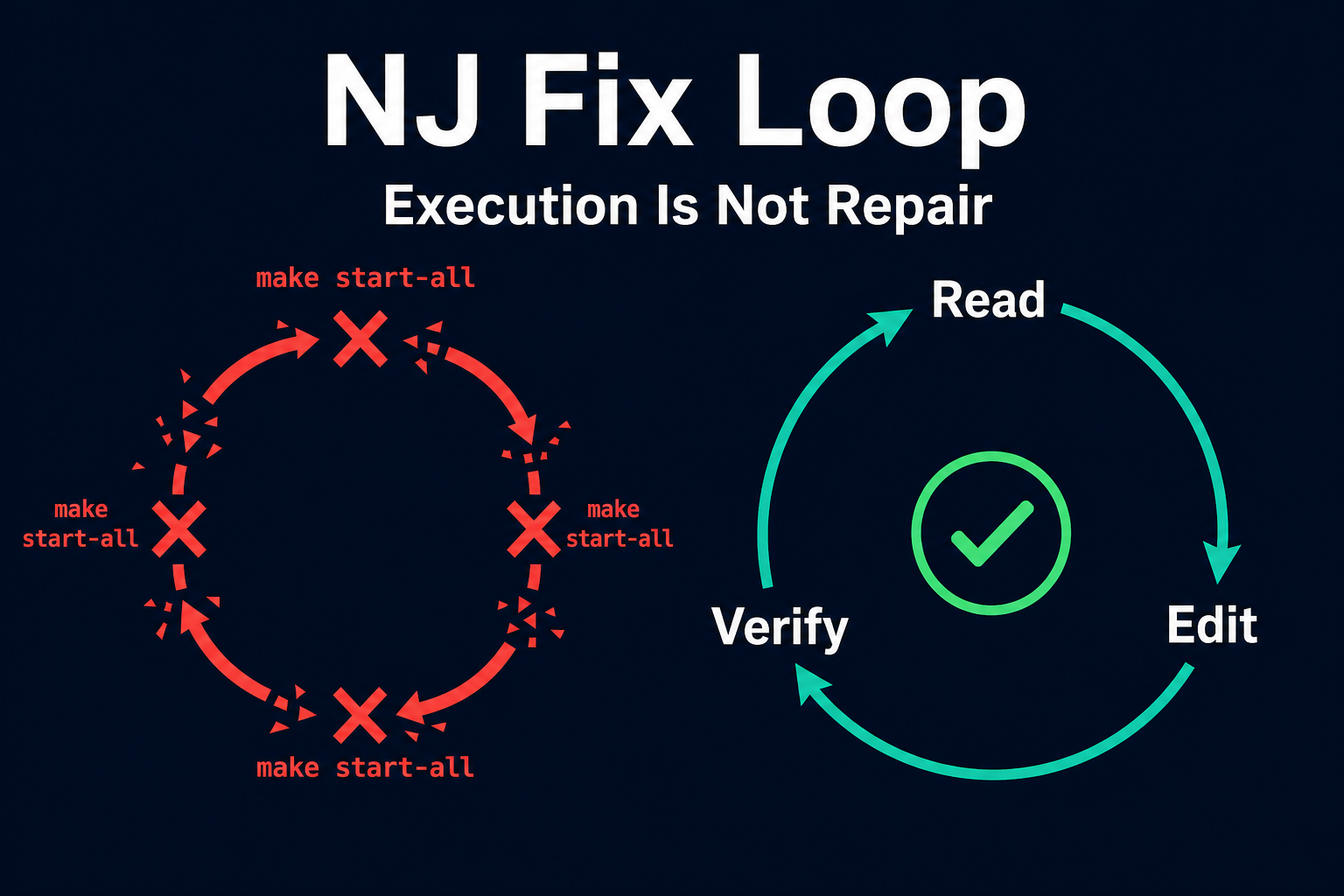
The agent runs make start-all. It fails. It runs it again. And again. Chat fills with command_output messages, but nothing on disk changes and sometimes there's no final summary at all.
That's not a model intelligence problem alone. It's a missing closed loop.
I've been building Neural Junkie as a local-first open-source agent hub. Agent Runtime v2 gives specialists long native tool loops — great for reach, dangerous without platform policy. This article is what we shipped as the NJ Fix Loop.
The gap: execution without repair
In a real boot-fix session we saw:
make start-allfailed 8× withNo rule to make target 'start-all'- 11 command_output posts in chat
- Zero file edits, no
implementation_session_outcome, no user-visible wrap-up
The outer implementation session only advanced on file proposals and verify. Tool-step observers tracked discover tools, not run_command failures. Failures were broadcast to the channel (and mirrored in the terminal panel) but never forced read → edit → re-run.
"My agent can execute" ≠ "my agent can fix my app."
What the NJ Fix Loop adds
Platform-owned policy on top of the tool loop:
1. Command telemetry + circuit breaker
Every run_command in an implementation session is recorded. If the same command fails twice without an intervening read_file or edit, the third run is blocked at the MCP layer — even if the model keeps trying.
2. Boot-fix grounding gates
For boot/build intent, agents must read Makefile, package.json, or scripts/start-all.sh before make start-all or npm run dev. The gate is enforced in tools, not just prompts.
3. Deterministic playbooks
Known error signatures trigger platform repairs before (or instead of) model guessing. Example: No rule to make target 'start-all' when scripts/start-all.sh exists → propose a start-all: Makefile target wiring to that script.
4. Guaranteed session finale
Every implementation session ends with a chat summary and implementation_session_outcome metadata — including command_failures, playbook_used, and circuit_breaker_triggered when relevant. Command-only thrashing can't exit silently.
5. Routing boot-fix to implementers
Boot-fix signals route to FrontendEngineer (ide_route_agent_type: frontend), not SoftwareArchitect — design questions still go to architects; "my app won't boot" goes to implementers.
Architecture (state machine)
stateDiagram-v2
    [*] --> Discover
    Discover --> Edit: groundingSatisfied
    Edit --> Verify: fileProposalApplied
    Verify --> Repair: verifyFailed
    Repair --> Edit: repairNote
    Discover --> Playbook: repeatedCommandFailure
    Edit --> Playbook: repeatedCommandFailure
    Playbook --> Verify: deterministicFixApplied
    Verify --> Outcome: successOrExhausted
    Repair --> Outcome: maxRepairs
    Discover --> Outcome: commandThrashingLimit
    Outcome --> [*]
Proof in the repo
Parity scenario: tauri-make-start-all-missing
make implement-scenario SCENARIO=tauri-make-start-all-missing
Fixture: React + Tauri workspace with a valid scripts/start-all.sh but a broken Makefile (no start-all target). Expect Makefile repair, session summary, and no unbounded command spam.
Key code paths:
internal/agent/implementation_command_policy.go— telemetry, circuit breakerinternal/agent/implementation_playbooks.go— Makefilestart-allplaybookinternal/mcp/workspace/workspace_mcp.go— MCP guards onrun_commanddesktop/src/utils/bootFixRouting.ts— boot-fix routing to frontend
What we didn't try to solve (yet)
- Rewriting Agent Runtime v2 into a single monolithic planner
- Fixing individual user repos by hand in agent sessions
- Unified timeline UI correlating tool steps, commands, and edits (tracked separately)
The bet: platform policy beats bigger models for reliability on boot-fix loops.
Try it
Docs: IMPLEMENTATION_SESSION.md
Cursor parity: CURSOR_PARITY.md
Download: https://camronwood.github.io/neural-junkie/download.html
Restart hub + desktop after pulling agent changes, then send a boot-fix request in Agent mode with auto-apply enabled.
Neural Junkie is a personal open-source project. Feedback and scenario failures welcome on GitHub.