
(paste below the line)
You Can’t Unit Test a Conversation. So I Built This Instead.
Neural Junkie is a desktop hub where specialists you control can chat, review code, and run structured multi-agent collaborations. Getting the orchestrator right — phases, turn-taking, task graphs, workspace gates — is hard enough. Getting conversation quality right on top of that is a different problem entirely.
A greeting shouldn’t dump MCP tool blocks. A “thanks, that’s all” should close cleanly instead of re-explaining. A /collaborate planning thread should reach review with structured tasks, not infinite grounding spam. And when execution finishes, the file on disk should reference core/sample/main.go, not a hallucinated index.js.
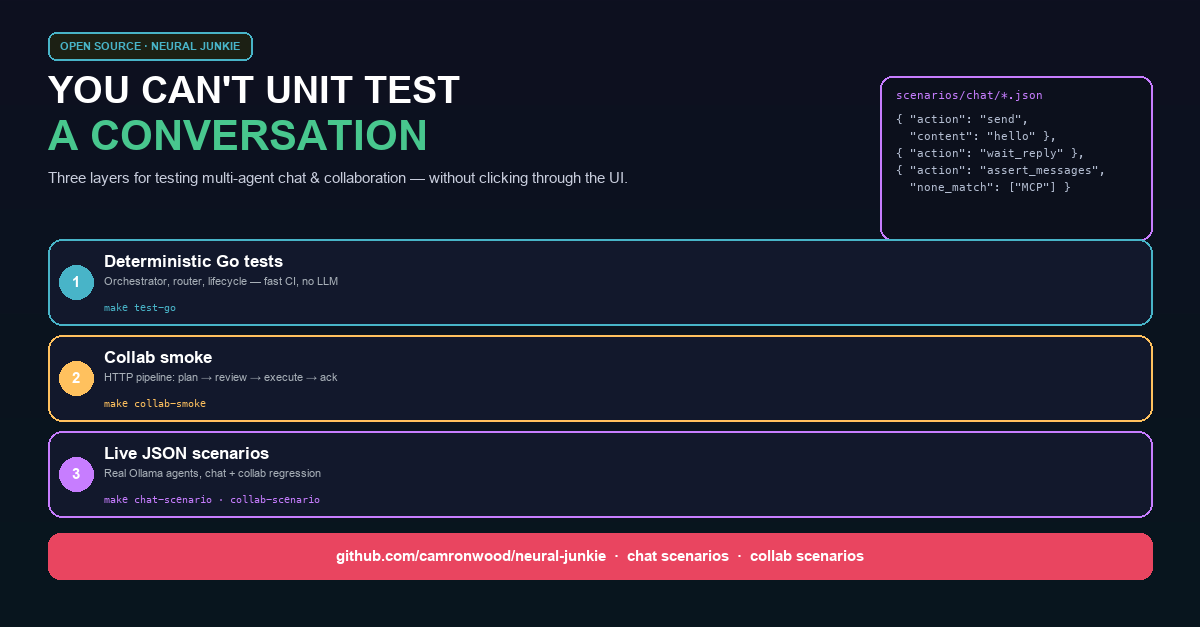
You can’t capture that with a single go test that mocks the LLM. You also can’t rely on manually clicking through the desktop app every time you tweak a prompt. So I built a three-layer test harness — and split chat from collaboration because they fail in different ways.
The problem: two different things to test
When people say “test the agents,” they usually mean one of two things:
-
Does the hub enforce the rules?
Phase transitions, discussion budgets, DAG readiness, “only one executing collab per channel,” artifact versioning, workspace ack before dispatch. This should be deterministic. The LLM is irrelevant. -
Do real models behave well in conversation?
Tone, closure, tool spam, plan shape, silent agents, grounded file content. This is inherently flaky — models change, prompts drift, Ollama load varies. You still need regression signal; you just can’t pretend it’s a unit test.
Mixing those concerns into one test suite gives you either false confidence or endless CI pain. The harness keeps them separate on purpose.
Layer 1 — Deterministic Go tests (fast, CI always)
What it covers: orchestrator logic and the Conversation Context Stack router — not model output.
Collaboration: lifecycle transitions, turn-taking, consensus, task assignment, plan parsing, dependency cycles, artifact edits. See test/collaboration_test.go.
Chat quality router: table-driven cases in internal/agent/chat_quality_router_test.go — intent (closure / casual / substantive / task), conversation mode (chat / code / collab), tooling gates, history caps, persona tier. This is the Layer A foundation described in CONTEXT_MODEL.md.
make test-go # entire module; chat router + collab tests included
These run on every change. They tell you the machinery still works. They do not tell you whether @Assistant will stay under 1200 characters on “hello.”
Layer 2 — Collab smoke (CI-friendly pipeline proof)
What it covers: the same HTTP surface the desktop uses — POST /api/send, GET /api/collaborations, POST /api/collaboration-workspace-ack — through planning → review → executing → cancel, with one synthetic discussion turn standing in for agent chatter.
make collab-smoke
Implemented in test/collab_smoke_api_test.go. No Ollama, no live agents, no flakiness. It catches wiring regressions: “approve plan” no longer transitions phase, workspace ack endpoint broke, collaboration redirect missing from send response.
This is the thin path that proves the pipeline still connects after hub changes. It’s not conversation quality; it’s integration smoke.
Layer 3 — Live JSON scenarios (real agents, local dev loop)
What it covers: multi-turn conversation and multi-agent collaboration with real in-process agents (typically local Ollama models) against a live hub.
Two runners, two scenario directories, same design language:
| Harness | Scenarios | Runner | Make target |
|---|---|---|---|
| Chat | scenarios/chat/*.json |
scripts/chat-scenarios.py |
make chat-scenario SCENARIO=… |
| Collaboration | scenarios/collab/*.json |
scripts/collab-scenarios.py |
make collab-scenario SCENARIO=… |
| Learning / LoRA | scenarios/learning/*.json |
scripts/learning-scenarios.py |
make learning-scenario SCENARIO=… |
Prerequisites: hub running (make server or make gui), agents online, models configured. For sweeps, start the hub with NEURAL_JUNKIE_RATE_LIMIT=0 so scenario polling doesn’t hit HTTP 429.
These stay local-only. They need time, GPU, and model availability. CI keeps Layers 1 and 2 green; Layer 3 is where I iterate on prompts and agent behavior.
Chat scenarios: conversation quality without collab noise
Chat scenarios test 1:1 and channel chat — greetings, closure, opinion questions, mode flips from casual to code review, DMs via the real channel API.
Example: greeting-chat-mode sends “hello” in chat mode and asserts the reply has no MCP blocks, no FILE_CHANGE, no kubectl, and stays under a character cap:
make chat-scenario SCENARIO=greeting-chat-mode
Other scenarios cover:
thanks-closure— substantive answer, then “ok thanks” → canned closurealready-said-closure— “I know you said that already” → won’t-repeat closurecasual-opinion-chat— chat mode opinion without grounding spamtask-flip-review— hello, then a code review request; asserts debug intent istaskdm-greeting— same structural checks through a real DM channel
Steps are declarative: send, wait_reply, assert_messages, assert_reply_count, assert_debug_context. When a step fails, the runner prints pass/fail per step and dumps the last ~12 transcript lines. No guessing why @Assistant went silent.
Full reference: CHAT_SCENARIOS.md.
Collab scenarios: phases, plans, files on disk
Collaboration scenarios drive /collaborate end-to-end — or slice off just the planning phase for fast iteration.
Fast planning loop (planning-two-agent):
make collab-scenario SCENARIO=planning-two-agent
The scenario waits for planning, checks each agent spoke (wait_discussion with min_per_agent), waits for reviewing, asserts no Grounding: I loaded spam, and validates the parsed plan has at least two tasks with sane titles.
Full execution loop (execute-deliverable):
make collab-scenario SCENARIO=execute-deliverable PROFILE=fast
This runs against a fixture repo (scenarios/fixtures/minimal-repo). It approves the plan, acks the workspace, waits for task completion, hub-approves file changes, and asserts findings.md exists with content grounded in core/sample/main.go — while explicitly rejecting hallucinated paths like index.js.
Collab steps include everything chat has, plus collaboration-specific actions:
wait_phase,wait_discussion,wait_planning_recapassert_plan(min tasks, title patterns)approve_plan,workspace_ackwait_tasks,approve_file_changes,assert_files
Profiles swap agent rosters without rewriting scenarios: PROFILE=fast uses lighter 7b agents; PROFILE=realistic uses heavier architect/backend pairs. make collab-scenario-matrix sweeps profiles and round budgets before/after prompt changes.
Other notable scenarios:
multi-collab-isolation— planning works while another collab executes elsewhereresource-api-schema-planning— production-shaped goal with explicit agent lanesdelivery-sandbox-auto-ack— sandbox workspace auto-ack on approve
Full reference: COLLABORATION.md § Live scenario harness.
What makes the harness useful when something breaks
The runners are built for diagnosis, not just pass/fail.
Chat failures dump recent transcript lines. Common causes: agent offline, slow model timeout, rate limit (restart hub with NEURAL_JUNKIE_RATE_LIMIT=0), missing NEURAL_JUNKIE_DEBUG=1 for debug-context assertions.
Collab failures add a discussion diagnosis block: per-agent message counts, who stayed silent, handoff counts. That’s how I fix “Gemini never talked” or “plan never reached reviewing” without spelunking logs for an hour.
wait_discussion is the collab-specific insight. Orchestrator tests prove turn-taking rules exist; live scenarios prove agents actually use their turns.
KEEP=1 leaves the collab or channel history intact for manual inspection:
make collab-scenario SCENARIO=planning-two-agent KEEP=1 VERBOSE=1
make debug-collab COLAB=<id8> LIVE=1
When a scenario fails, it becomes the next scenario I add or tighten. That’s the dev loop.
Principles I keep coming back to
-
Test the orchestrator in code; test the conversation in scenarios. Don’t assert LLM prose in Go table tests. Don’t skip lifecycle tests because “the agents seemed fine yesterday.”
-
Separate chat from collab. Chat mode closure and collab planning recap are different failure modes. One runner per domain keeps scenarios readable.
-
Assert structure, not poetry.
min_tasks: 2,none_match: ["MCP"],any_match: ["main\\.go"]— pattern checks that survive model upgrades better than exact string equality. -
Ground scenarios in fixture repos. Execution tests that only check chat markdown lie. Files on disk with real path constraints catch hallucinated project structure.
-
CI for speed; live scenarios for truth. Layers 1–2 gate merges. Layer 3 gates releases and prompt refactors.
-
Failures become scenarios. Every production “collab hung in review” or “agent dumped tools on hello” gets encoded as JSON so it doesn’t come back.
If you’re building something similar
You don’t need Neural Junkie to steal the pattern:
- Layer 1: pure logic your product owns (state machine, router, caps) — table tests, no model.
- Layer 2: HTTP/API smoke through the same paths your UI uses — synthetic events where agents would talk.
- Layer 3: declarative JSON scenarios against a live stack —
send/wait/assertsteps, transcript dumps on failure, optional matrix sweeps.
The JSON scenario format is intentionally boring. Boring is good. When a prompt change breaks planning quality, you want a one-line make collab-scenario failure, not a vague “felt worse in manual testing.”
Try it
Neural Junkie is a personal open-source project (macOS, Windows, Linux).
Download: https://github.com/camronwood/neural-junkie/releases/latest
Run the harness:
make server                                    # or make gui
make test-go                                   # Layer 1
make collab-smoke                              # Layer 2
make chat-scenario SCENARIO=greeting-chat-mode # Layer 3 — chat
make collab-scenario SCENARIO=planning-two-agent # Layer 3 — collab
Docs: CHAT_SCENARIOS.md · COLLABORATION.md · CONTEXT_MODEL.md
If you add a scenario or hit a failure mode the harness doesn’t cover yet, GitHub issues welcome — that’s how the JSON files grow.
Camron Wood — Neural Junkie (personal project)