
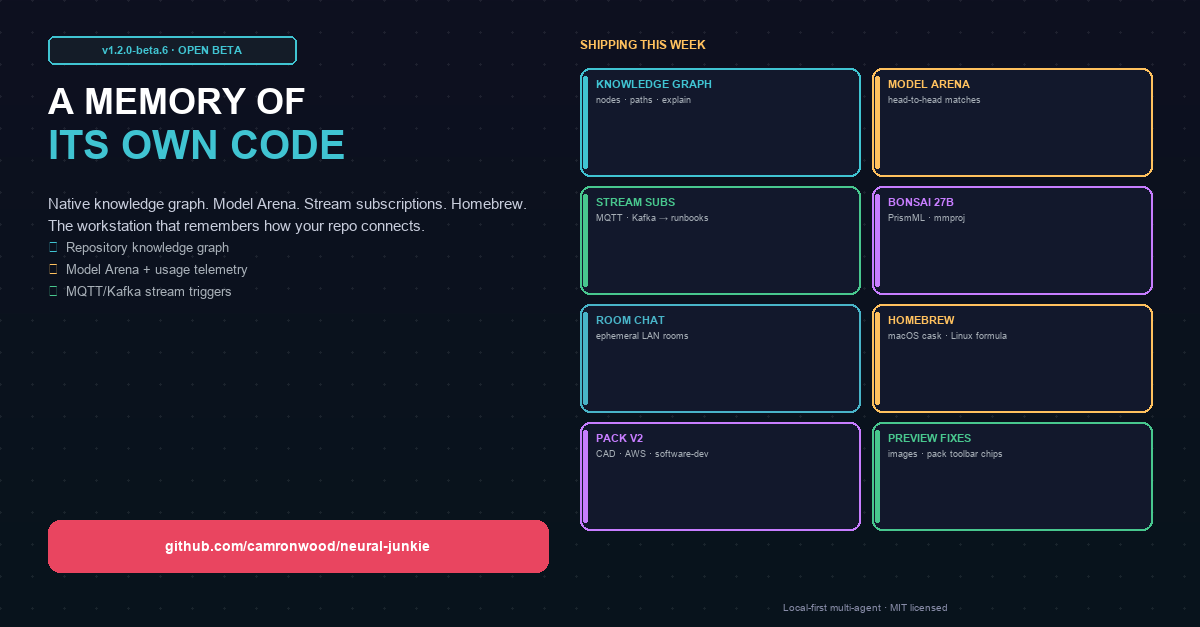
Neural Junkie v1.2.0-beta.6 is the open-beta release where the workstation stops treating your repo as a bag of files and starts treating it as a graph of relationships you can explore, query, and ground agent turns on.
If beta.5 closed the operational loops — ReAct tools, routing trace, Runbooks v2, collab hardening — beta.6 is what happens when that stack meets code memory: a native knowledge graph, head-to-head Model Arena, event-driven stream subscriptions, and distribution polish (Homebrew on macOS and Linux) so beta users can install and update without hunting GitHub assets.
Download: macOS, Windows, Linux — same local-first desktop app, same MIT-licensed hub. Prefer Homebrew? brew tap camronwood/tap then install the cask (macOS) or formula (Linux).
The headline in one paragraph
You get a repository knowledge graph (index, APIs, IDE workbench, and a code_graph agent route), Model Arena with reliable matches and inference usage telemetry, MQTT/Kafka stream subscriptions that fire runbooks or channels, PrismML Bonsai 27B in the model library, Room Chat for ephemeral LAN rooms, Homebrew distribution, domain pack v2 plumbing, and the everyday fixes that matter when you live in the app: workspace image previews and pack toolbar chips that appear on enable.
1. Repository knowledge graph — memory of its own code
Beta users kept asking the same class of question: how does this relate to that? who calls this? what path connects A to B?
Beta.6 ships a native graph under the hood:
- Build and store a code graph for the active workspace
- Query subgraphs, paths, and node explain
- Open a Knowledge Graph workbench in the IDE (toolbar chip, Files panel, or
/nj-open-knowledge-graph) - Route agent turns through
code_graphwhen the question is about relationships, not just chunks
This is not a separate SaaS product bolted on. It is part of the same hub that already indexes your repo for @codebase — now with structure you can see and navigate.
Deep dive: Knowledge graph docs · feature guide
2. Model Arena — put two models in the ring
Packs are how Neural Junkie grows without bloating the core. Model Arena is the beta.6 pack headline for people who care about model quality in the open:
- Head-to-head matches with observable status
- Hardened move handling so sessions do not stall mid-match
- Inference usage telemetry so you can see what a run actually cost in tokens and time
It is the same local-first philosophy: your hub, your models, your ring.
3. Stream subscriptions — MQTT and Kafka that fire work
Chatbots that sit on a topic and narrate every message are the wrong abstraction. Beta.6 continues the stream-subscription story: long-lived MQTT/Kafka listeners that match messages and do something useful — run a runbook, post into a hub channel, or hit a webhook.
Settings UI included. Your ops bus stays an ops bus; Neural Junkie becomes the agent that reacts when the signal matches.
4. Models and rooms — Bonsai, Room Chat, Homebrew
Three distribution and access wins for beta users:
- PrismML Bonsai 27B lands in the model library with
mmprojsupport, prompted Ollama updater guidance, and min-version gates so you are not guessing which runtime works. - Room Chat pack: ephemeral LAN rooms hosted on a host hub — bring a room online without standing up a permanent team channel.
- Homebrew:
brew install --cask neural-junkieon macOS andbrew install neural-junkieon Linux fromcamronwood/tap, with automated tap bumps on release.
5. Packs and polish that show up immediately
Domain pack v2 plumbing continues for CAD, AWS, and software-development. Platform foundations add turn pipeline, span tracing, and durable collab state.
And the two bugs that make a beta feel unfinished:
- Workspace image previews — PNGs in your project open in the editor again (hub data URLs + wider Tauri asset scope).
- Pack toolbar chips — enable a pack with a toolbar capability and the chip appears without needing an IDE layout refresh.
Small? Yes. Visible every day? Also yes.
What we are still honest about
Open beta means we ship progress and name the gaps. The live parity gate (test-parity-stable-restart) is still failing and is tracked for a follow-up beta. Release CI still runs the unit and race gates that block installers; the live-model parity suite is the next bar we intend to clear.
Known issues page stays the source of truth for what is still wrong on purpose.
Get it
- Releases: v1.2.0-beta.6
- Download page: camronwood.github.io/neural-junkie/download.html
- Homebrew:
brew tap camronwood/tapthen install cask or formula - Changelog: docs/CHANGELOG.md
Star the repo if this is useful. File issues if something breaks. Beta.6 is for people who want a local multi-agent workstation that can see how code connects — not just retrieve the nearest chunk.