
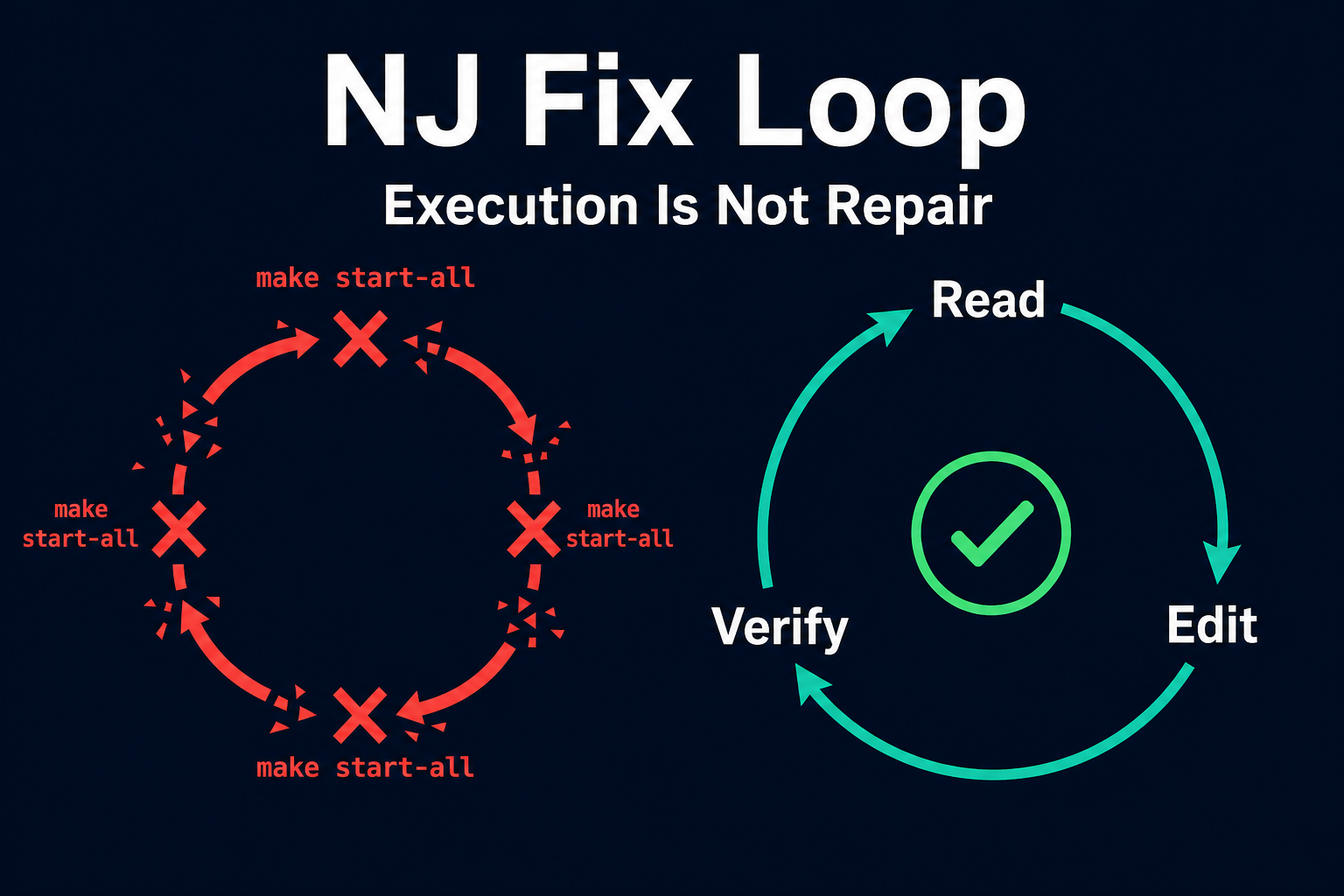
The gap
An agent that can run_command can still fail to fix your app. A typical boot-fix session might run make start-all eight times, fill chat with command_output messages, and never touch disk.
Execution without repair is a platform problem, not just a model problem. The NJ Fix Loop adds hub policy so failures force read → edit → verify and a user-visible summary.
What ships in the Fix Loop
- Command telemetry — every
run_commandresult recorded in session state. - Circuit breaker — same failing command twice without a read or edit in between blocks a third run.
- Boot-fix grounding —
make start-all/npm run devblocked untilMakefile,package.json, or startup scripts were read. - Playbooks — known signatures (e.g.
No rule to make target 'start-all') trigger deterministic repairs when fixtures exist. - Session finale — every implementation session posts a summary plus
implementation_session_outcomemetadata.
Where it runs
Fix Loop policy applies during IDE Agent mode implementation sessions — the same path as stack manifest injection, grounding gates, verify/repair, and auto-apply when editor trust allows. Boot/build failure signals route to FrontendEngineer when the composer detects them.
See also IDE v4 and IDE v3 for Ask/Agent routing and editor trust modes.
Status
Fix Loop shipped in v1.2.0-beta.4 and remains the default repair policy for IDE Agent implementation sessions. See beta.4 release notes and CHANGELOG.